
Карта
The Middle Corridor: volumes, routes and the cost of a container
- Middle Corridor
- Northern Route
- Railways
- Freight Rates
- Iran
On World Bank figures, the Middle Corridor carries about 5% of the Northern Route's volume through Russia, even after its cargo grew more than tenfold between 2021 and 2024. Its price sits close to the Northern Route's, at US$2,500 to 3,250 for a 40-foot container in the Bank's survey of May 2023, and in the Bank's stage breakdown of the trip, three ports account for 32 of 50 days.
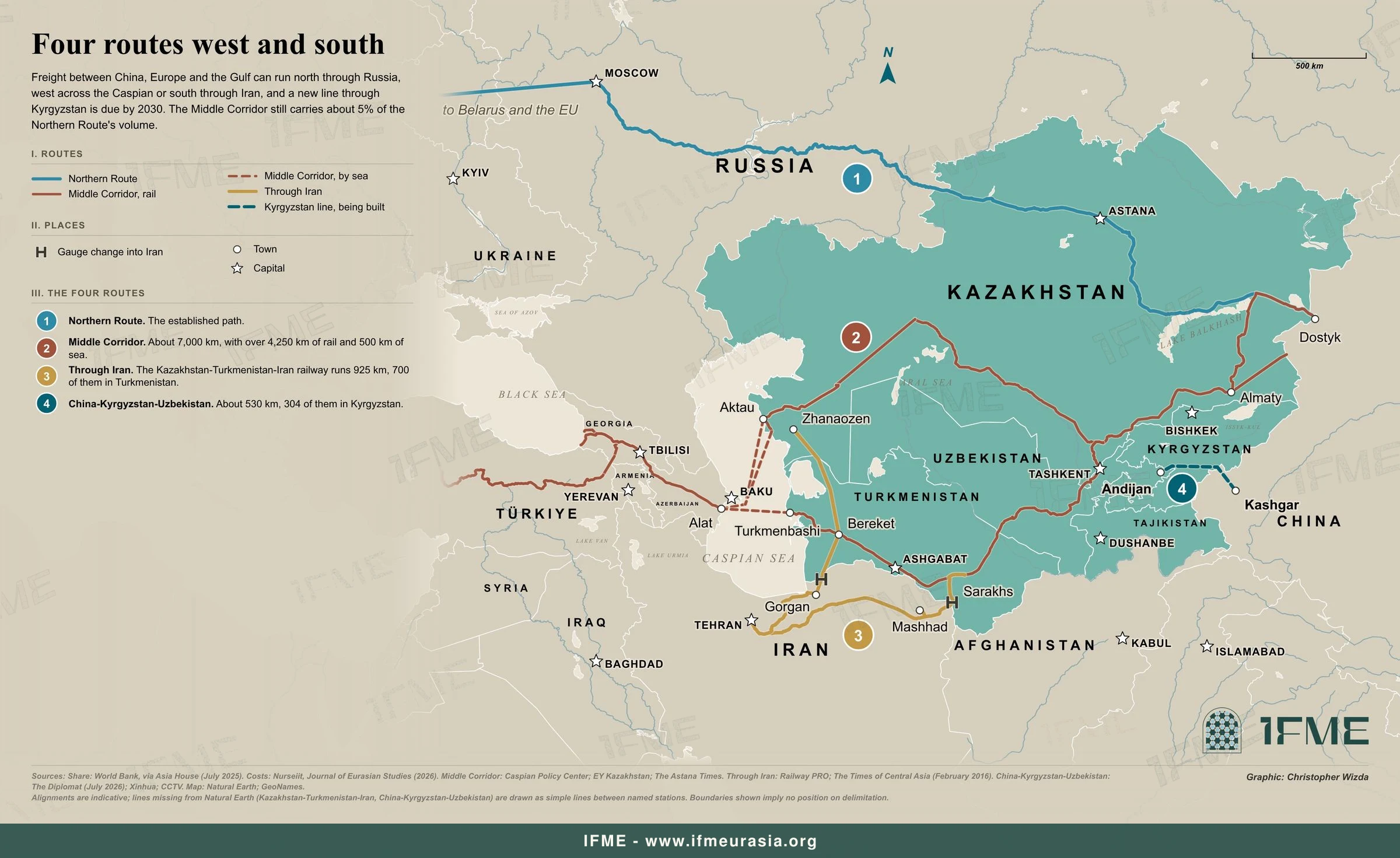
The map traces four rail paths west and south, through Russia, across the Caspian, through Turkmenistan into Iran and along the China-Kyrgyzstan-Uzbekistan line under construction. The chart sets the corridor's tonnage against the Northern Route, and the infographic follows one container through each stage of the trip.
1. Four routes west and south
Nurseiit, writing in the Journal of Eurasian Studies in 2026, puts the 2022 cost of moving a TEU at about US$3,000 on the Northern Route through Russia and about US$4,000 across the Caspian.
That route, through Kazakhstan and Russia, remains the established path for freight between China and Europe, and on World Bank figures reported by Asia House in July 2025, Middle Corridor traffic is about 5% of its volume.
The Middle Corridor runs about 7,000 km across Kazakhstan, the Caspian, Azerbaijan and Georgia, over 4,250 km of it by rail and 500 km by sea, with a southern feeder through Uzbekistan and Turkmenistan to Turkmenbashi. Freight took 13 to 17 days on it from China to Europe in reports from March 2026. In August 2026, the secretary general of the TITR Association named the sea itself among the route's limits.
"Additional limiting factors remain the falling level of the Caspian Sea and adverse weather conditions."
Nurgul Zhakupova, Secretary General of the TITR Association, in "Middle Corridor Must Cut Delays, TITR Chief Tells TCA," The Times of Central Asia (August 2026).
Both rail entries into Iran on the map cross from Turkmenistan. The Kazakhstan-Turkmenistan-Iran railway runs 925 km, 700 of them in Turkmenistan, from Uzen station at Zhanaozen in Kazakhstan through Bereket and Etrek to Gorgan (Railway PRO), and the presidents of the three countries opened it at the Turkmen-Iranian border on December 3, 2014 (The Astana Times). The other entry is at Sarakhs, where the first container train from China to Iran via Turkmenistan crossed on February 10, 2016, after leaving Yiwu on January 28, bound for Tehran (The Times of Central Asia). Both crossings change gauge, from 1,520 mm to Iran's 1,435 mm.
The fourth path, the China-Kyrgyzstan-Uzbekistan railway, is under construction and will run about 530 km, 304 of them in Kyrgyzstan. Financing was signed in Bishkek on December 16, 2025, for a project that The Times of Central Asia put at an estimated US$4.7 billion. About US$2.3 billion is a 35-year loan from a syndicate of Chinese banks, including China Development Bank and Eximbank, and the other US$2.3 billion goes into the project company's authorized capital, 51% from China and 24.5% each from Kyrgyzstan and Uzbekistan. The Diplomat reported in July 2026 that completion is targeted by the end of 2030. On September 5, 2026, the 209.6 m Kosh Dobo North No. 2 tunnel became the first tunnel on the Kyrgyz section to break through (Xinhua), and CCTV put the section at 17% complete.
The first China-Iran container train covered 3,417 km in Kazakhstan before it reached Turkmenistan, and the Kyrgyz line is being built to bring Chinese freight into Uzbekistan without crossing Kazakhstan at all.
Notes. Alignments are indicative; lines missing from Natural Earth (Kazakhstan-Turkmenistan-Iran, China-Kyrgyzstan-Uzbekistan) are drawn as simple lines between named stations.
2. The Middle Corridor in proportion
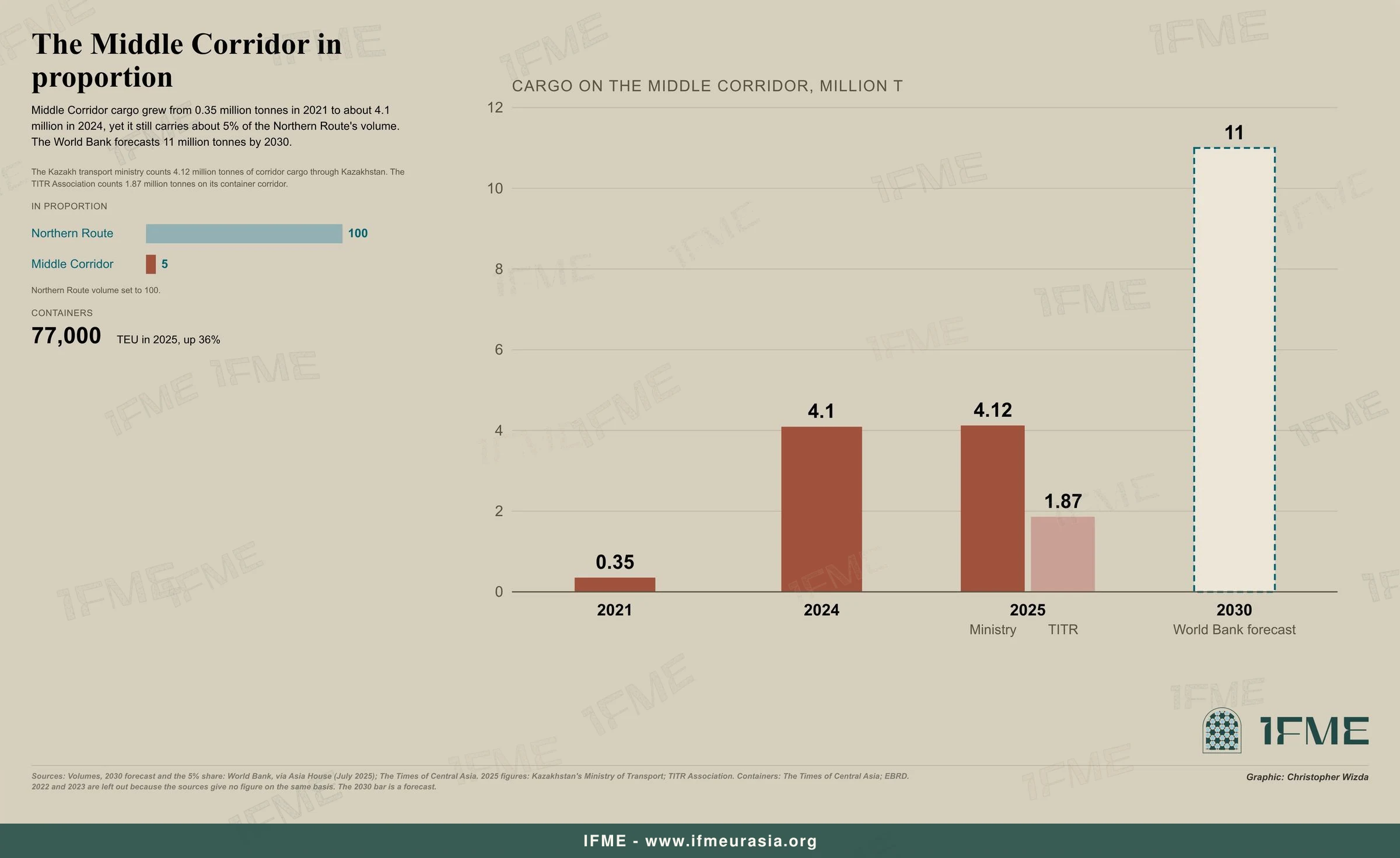
Cargo on the Middle Corridor rose from 350,000 tonnes in 2021 to about 4.1 million in 2024, according to World Bank figures that Asia House reported in July 2025.
That is more than tenfold growth from a small base, and on the same World Bank figures, Middle Corridor traffic is about 5% of the Northern Route's volume through Russia. The chart sets the Northern Route at 100 so that the share can be read directly. The years 2022 and 2023 are left blank because the sources used here give no figure for them on the same basis as the World Bank series.
For 2025, the total depends on who does the counting. Kazakhstan's Ministry of Transport reported 4.12 million tonnes of corridor cargo through Kazakhstan, below the 4.48 million it counted for 2024. The TITR Association counts 1.867 million tonnes on its container corridor, which is a different measure, so the chart shows both figures side by side. Container traffic rose 36% in 2025 to about 77,000 TEU, The Times of Central Asia reported, so the count of containers grew in a year when the ministry's tonnage fell.
When the World Bank released its study of the corridor on November 27, 2023, it said volumes could triple and travel time halve by 2030 if the right investments and policies were in place (World Bank).
"Our new data confirms that the Middle Corridor is not only viable but can also become essential to the economies of countries along the route."
Antonella Bassani, World Bank Vice President for Europe and Central Asia, in "Middle Corridor through Central Asia, Caucasus Can Boost Trade, Connectivity and Supply Chain Resilience, Says New Report," World Bank press release (November 27, 2023).
The forecasts now on record assume that growth continues. The World Bank expects 11 million tonnes by 2030, as Asia House reported it, and the EBRD estimates that transit container volume could reach 130,000 TEU by 2040 (EY Kazakhstan, citing the EBRD) and puts the Central Asian investment need at about EUR 18.5 billion.
Measured against this chart, 11 million tonnes would be about 2.7 times the 4.1 million of 2024, and 130,000 TEU would be about 1.7 times the 77,000 carried in 2025.
Notes. 2022 and 2023 are left out because the sources give no figure on the same basis. The 2030 bar is a forecast.
3. One container, three routes
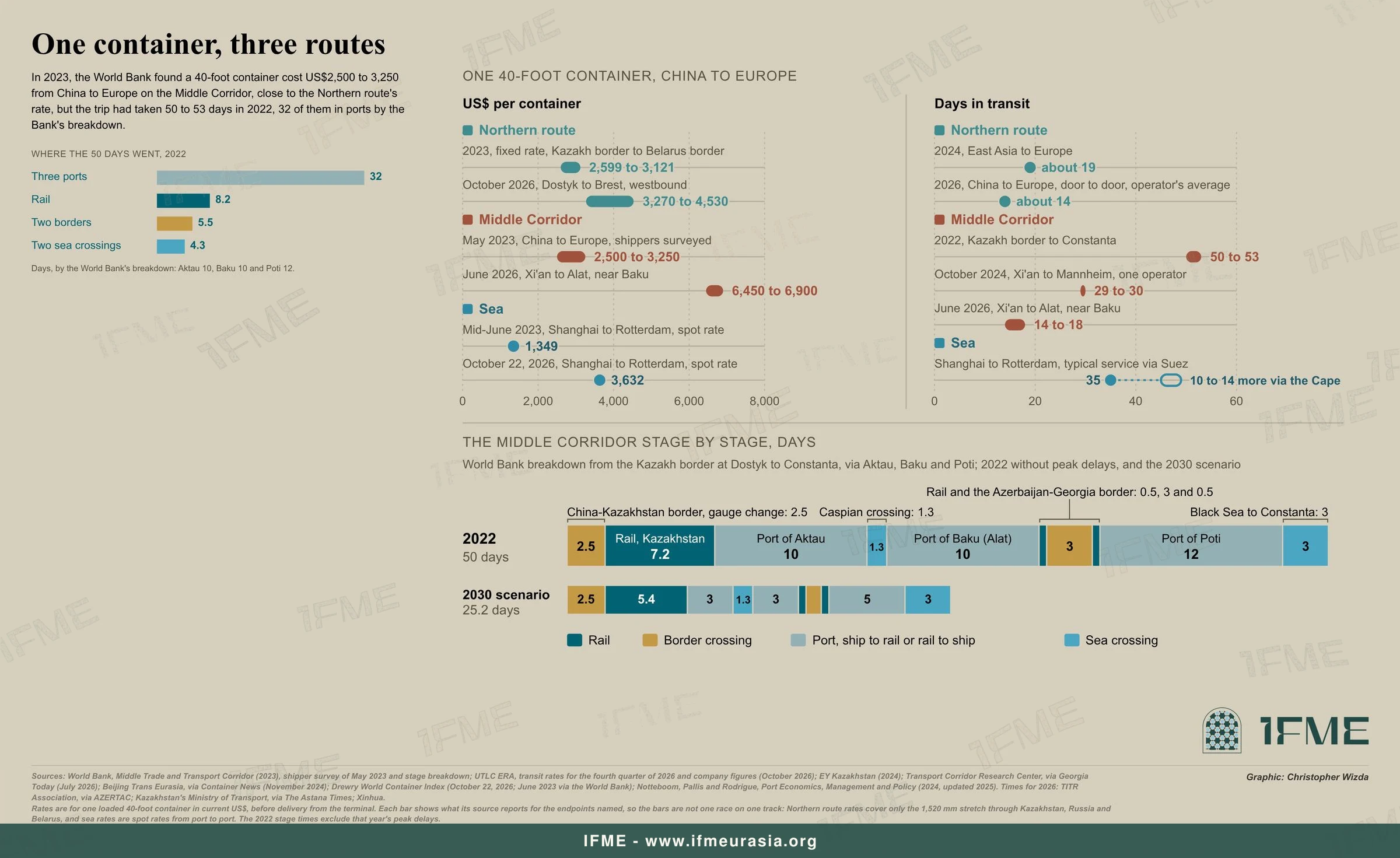
In May 2023, a World Bank survey of shippers, carriers and forwarders put the cost of moving one 40-foot container from China to Europe on the Middle Corridor at US$2,500 to 3,250, which the Bank found close to the Northern Route's rate. Even so, the trip from the Kazakh border to Constanta had taken 50 to 53 days in 2022.
The World Bank's study set that price beside the fixed rate UTLC ERA then charged on the Northern Route through Russia, US$2,599 eastbound and US$3,121 westbound. That rate covers only the 1,520 mm stretch from the Kazakh border to the Belarus border, through Kazakhstan, Russia and Belarus, so it leaves out rail in China and in the EU, and the visual shows each figure with the endpoints its source names.
The Bank's stage breakdown, compiled from national documents and the investment programs of railways and ports, leaves out 2022's peak delays and comes to 50 days. A container spent 2.5 days changing gauge at Dostyk, 7.2 days on Kazakh rail, 10 days in the port of Aktau, 1.3 days crossing the Caspian, 10 days at Baku (Alat), 0.5 days on Azerbaijani rail, 3 days at the Azerbaijan-Georgia border at Gardabani, 0.5 days on to Poti, 12 days in Poti and 3 days across the Black Sea. Three ports account for 32 of the 50 days, against 8.2 days on rail and 4.3 at sea. The port data in the Bank's report give a longer stay at Alat in 2022, 27 days on average for the complete transit through the port.
"The longest delays occur at sea crossings, even with port capacity surplus (...) the main problems reported related to shortage of vessels, followed by errors in shipping documentation."
World Bank, Middle Trade and Transport Corridor: Policies and Investments to Triple Freight Volumes and Halve Travel Time by 2030 (2023), p. 8.
Kazmortransflot's round trip from Aktau to Baku and back took about 7 days in 2022, and the one-way voyage 3.5 days, of which 30 hours were the crossing itself, at 8 knots. On that voyage, it charged US$460 for a loaded 40-foot box. ASCO charged US$1,200 for a 40-foot container between Alat and Kuryk, 2.6 times Kazmortransflot's tariff, by the Bank's comparison, and port charges added US$148 at Aktau or Alat and US$275 at Poti. In 2022, Alat handled 52,277 TEU, and the port plans to grow from 100,000 TEU of capacity to 500,000.
In June 2026, a container block train from Xi'an to Alat, near Baku, took 14 to 18 days on average. The rate for a 40-foot container had risen from US$6,000 to 6,500 in March to US$6,450 to 6,900, which the Transport Corridor Research Center linked to instability in the Middle East, while carriers cited higher fuel and insurance costs (Georgia Today). From October 1, 2026, UTLC ERA's westbound rate from Dostyk to Brest stood at US$3,270 to 4,530. By sea, the Drewry World Container Index put Shanghai to Rotterdam at US$3,632 on October 22, 2026, against no more than US$1,349 in mid-June 2023. The map "Every break in the chain" (in the Observatory publication "Where freight stops: gauges, ports and border times") follows the corridor's transit times through 2026 and the breaks of gauge and mode behind them.
In the Bank's 2030 scenario, which assumes its recommendations are followed, the Caspian crossing stays at 1.3 days and the Black Sea at 3, and the time comes out of the ports, from 32 days to 11, with 3 days each at Aktau and Alat and 5 at Poti.
Notes. Rates are for one loaded 40-foot container in current US$, before delivery from the terminal. Each bar shows what its source reports for the endpoints named, so the bars are not one race on one track: Northern route rates cover only the 1,520 mm stretch through Kazakhstan, Russia and Belarus, and sea rates are spot rates from port to port. The 2022 stage times exclude that year's peak delays.
All IFME infographics uploaded to the database may be used freely, provided that the IFME and the author of the infographic in question are credited.