



The term Bessarabia originally refers solely to the region between the Danube and Dniester rivers, on the Black Sea coast. More or less, Izmail Oblast in today’s Ukraine. The name of the region came from the Wallachian[1] dynasty Basarab as the region was incorporated by Mircea the Elder (1386-1418) into the principality of Wallachia after he disbanded the remaining Tatar hordes in the area.[2] In the fifteenth century, these lands were slowly absorbed by the neighbouring Principality of Moldavia before the principality became a vassal of the Ottoman Empire in 1538. During the Ottoman rule, the region was called Budjak, which means the corner in Turkish, as it was one of the limits of the empire, at the frontier with other important powers like the Polish-Lithuanian Commonwealth and later the Russian Empire.
It is only after the Turkish-Russian war of 1806-1812 that Bessarabia obtained its modern geographical meaning. The Russians used the term to define not only the coastal area, but the whole strip of land that stretches between the Prut and the Dniester rivers. It was at the time the northern half of the principality of Moldavia, a buffer state under the suzerainty of the Ottomans. After the Turkish-Russian War of 1877-1878, which was ended by the Berlin Congress, Bessarabia was recognised as a Russian territory. The southern part of Moldova was merged with Wallachia to form the independent kingdom of Romania. The northern region of today’s Romania still holds the name Moldova as a reminiscence of the split of the former principality.
Today, two-thirds of Bessarabia constitute modern Moldova. The region is delimited in the west by the Prut River which flows to the Danube and serves as a natural frontier between Romania and Moldova. The eastern border is delimited by the Dniester River and the northern by the Chernivtsi Oblast in Ukraine. The last third of Bessarabia is the Izmail Oblast in southeast Ukraine, still referred to as Budjak. Even though Transnistria is mainly located behind the Dniester River, the history of the autonomous republic is closely linked to the region as well.
Bessarabia has always been a region at the periphery of the spheres of influence of various empires. From the Romans to the Russians, passing through the Ottomans or the Lithuanians, many powers came to rule the place but always at the limit of their capacities. Therefore, it might be considered as an “institutionalised borderland”,[3] an area that was always perceived as a border by its different rulers and a strategic chokepoint between southern and eastern Europe.
Bessarabia within Greater Romania.
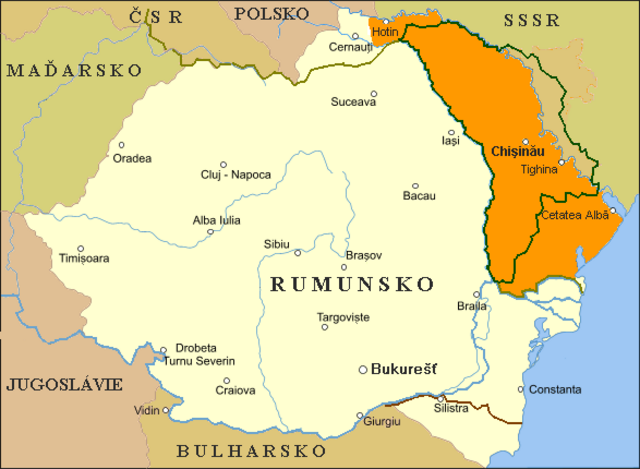
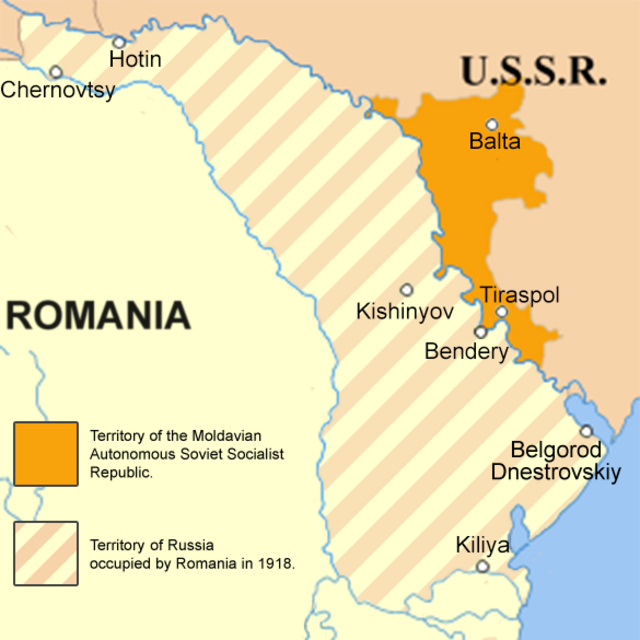
Map of Bessarabia and MASSR (1924-1940).
The birth of Bessarabia
After the Treaty of Bucharest in 1812, the Prut River became the new frontier between Russia and the Ottoman Empire. The lands annexed by Russia in 1812 consisted of three different types of territories[4]: The Eastern part of the principality of Moldavia, populated mainly by Romanians. The fortresses directly controlled by the Turks along the Dniester rivers (like Tighina-Bender or Soroca) with the surrounding areas under the rule of Ottoman governors. And the Budjak region, populated by Nogai tribes[5] under the former suzerainty of both the Crimean Khanate, until its fall, and the Ottoman Empire. These three areas were merged by the Russian Empire to create the new province of Bessarabia. Thus, the region was a patchwork of people with different cultures and religions and a specific framework of administration. Some voivodes[6] and other landowners used to have estates on both banks of the Prut River, now divided by the new frontier. The construction of the province was encouraged both on the institutional and discursive levels. But even if Bessarabia was now a part of the empire, it was perceived at first by Russian authors as an exotic land and a limit with semi-barbarous countries.[7] Nevertheless, the region received proper recognition with the development of formal administration. However, Bessarabia was granted the statute of gobierna (governorate), only in 1873.[8]
However, Russian expansion toward the south was soon perceived as a threat by other European powers. The “Eastern Question” emerged as one of the most important international crises of the nineteenth century. The territories of the Ottoman Empire, perceived as the “Sick Man of Europe”,[9] became a source of tension and rivalry for their control.[10]As Russia gained the upper hand in territorial expansion, it triggered the reaction of France and England, which launched a joint expedition to Crimea in support of the Ottomans. The British sought to maintain the balance of power in Europe and the status quo with Russia in Central Asia, while the French aimed to recover their position as a great power after the Napoleonic era and to present themselves as the protector of Eastern Christianity.
After the Crimean War 1853-1856, the Treaty of Paris gave southern Bessarabia (counties of Ismail, Cahul and Bolgrad) to Moldavia. The principality merged with Wallachia in 1859 to form Romania, an autonomous kingdom still under Ottoman suzerainty. Control of the Danube delta was given to Romania only for strategic concerns.[11] The reason was the willingness of the French and the British to contain Russia from dominating southern Europe by creating a buffer zone between Russia and the Ottoman Empire. The same logic applied years later after the success of the Russian army in the Russian-Turkish War of 1877-1878. The Treaty of San Stefano (1878) initially gave large gains to Russia. However, the European powers, led by England, forced Russia to renegotiate the San Stefano Treaty at the Congress of Berlin a few months later. Southern Bessarabia returned under Russian rule, but other territorial gains were lost. Romania received international recognition as an independent kingdom deemed to play the role of a buffer state.
Bessarabia in the turmoil of the Russian Revolution.
When the First World War broke out in Europe, Romania had to choose between three positions. Join the Central Powers, join the Entente or stay neutral and wait for any opportunities. The country had territorial revendications on the Transylvania and Bucovina regions, where important Romanian populations lived under the rule of the Austro-Hungarian Empire. Bessarabia was also perceived as a legitimate territory by the Romanian nationalist movement but to a lesser extent in terms of historical and cultural importance.[12] Endorsing a rational stance and a “bandwagoning”[13] foreign policy, Romania engaged itself in the war in 1916, alongside the Entente powers.[14] However, the war turned out poorly for the Romanian army, and the country was invaded by Austro-Hungarian, Bulgarian and German soldiers. The remaining Romanian troops managed to secure their position between the Siret and the Prut rivers, but most of the kingdom fell under foreign occupation. The situation became even more critical as Russia was about to face an unprecedented crisis. The 1917 February Revolution kept Russia in the war, but Kerensky’s offensive, planned in June, didn’t succeed in breaking Austro-German lines. The country started to disintegrate after the October Revolution.
In the midst of this chaos, Moldovan officers serving in the Russian army and local revolutionary committees gathered and created the Country Council, “Sfatul Țării”. The council, mainly composed of Romanian speakers, proclaimed a new status for Bessarabia as an autonomous republic of the Russian Empire. At the same time, the region was supposed to be controlled by a Soviet Executive Committee, “Rumcherod”.[15]At the end of 1917, the Rumcherod established the FrontOtdel, a Soviet organisation intended to create a general staff in Bessarabia in order to regroup Russian troops under Soviet control and manage the Romanian frontline. Even if the FrontOdel claimed to have no business with the internal situation of the region, the organization aimed to contest the direction of Bessarabia by the Sfatul Țării.[16]After weeks of rising tensions between the two organisations, the Sfatul Țării proclaimed the independence of Bessarabia on 6 January 1918. Fearing the reaction of the Bolsheviks, and to put an end to plundering from various warbands, the Sfatul Țării asked Romania to intervene. On 9 April, the union with Romania was signed.
Even if the annexation was voted by the Sfatul Țării, Romania had to gain the international recognition of Bessarabia as a new Romanian province. France, through the presence of the Eastern army, “Armée d’Orient” played a fundamental role in this annexation. During the war, a French mission led by the general Berthelot was sent to form and assist the Romanian army. When the civil war broke out in Russia, France supported the White faction and approved the Romanian intervention in Bessarabia to prevent the Bolsheviks from Odessa from seizing the region. However, France refused to directly recognise the province as Romanian because it was hoping for a victory of the Whites. Moreover, Russian White generals like Wrangel or Denikin claimed Bessarabia as a Russian province illegally annexed by Romania. At the end of the First World War, France’s foreign diplomacy tried to conciliate its support for Romania and its support for the Whites who could have restored Russia as a new ally to counter the Central Powers in case of future war.[17]Things changed swiftly as the Whites were losing ground and French expeditionary forces in southern Russia faced mutinies. Besides, during the Paris Peace Conference of 1919, Marshal of France, Ferdinand Foch, coined the term sanitary cordon, “cordon sanitaire”. Worried by the propagation of communist ideas, compared to a disease spreading in Europe[18] .Foch promoted a foreign policy of containment of communism. The White Russian army, and later Poland and Romania were seen as barriers to keep the communists out of Europe. Therefore, Romania occupied a strategic place and needed to be strong enough to repel possible communist expansion. Thus, the integration of Bessarabia into Romania was officially recognised at the Paris conference of 1920 without the presence of Soviet delegates.
With the annexation of Bessarabia, three eastern frontiers coexisted in the imaginary of Romanian nationalism. The Prut River as a cultural frontier where the Romanian national idea stops. The Dniester River which is the new political frontier that Romanian elites wanted to incorporate into the cultural frontier by promoting Romanian national history in Bessarabia. And the ethnolinguistic frontier, composed of Romanian speakers living beyond the Dniester in Ukraine and considered by some nationalist actors as a possible new political frontier.[19] However, on the Russian side, Bessarabia was still perceived as a former territory illegally occupied by Romania. After the end of the civil war, communist leaders finally had the opportunity to consolidate their regime. At the beginning of the 1920s, the initial willingness to export the revolution was left aside for a more pragmatic approach of socialism in one country.[20] Despite the acceptance of coexistence between the USSR and its neighbours, the issue of Bessarabia was a thorn in its relations with Romania. Serials of talks and informal meetings took place between the two sides but without any results.[21] Moreover, communist agents were highly active in Bessarabia, promoting Soviet values and encouraging the people to revolt against the Bucharest regime. The most notorious attempt to challenge Romania’s hold over the region was the Tatarbunar revolt in September 1924, in southern Bessarabia. Local communist organisations supported by Soviet secret services managed to take control of Tatarbunar and its vicinities, proclaiming the Moldavian Soviet Socialist Republic in southern Bessarabia. However, the insurgents didn’t succeed in creating a large revolutionary movement, and the rebellion was crushed by the Romanian army a few days later.[22] A few weeks after the repression, on October 12, a Moldavian Autonomous Soviet Socialist Republic (MASSR) was proclaimed in Ukrainian territories. The creation of this Transnistrian republic was supposed to be the spearhead of a socialist revolution in Bessarabia. In fact, until the 1940s, the Soviets multiplied propaganda actions through the use of newspapers or journals like Red Bessarabia, “Krasnaja Bessarabija”.[23] In its first issue published in 1926, the journal commemorates the Tatarbunar revolt and emphasises the violence and the mass terror conducted by the “Romanian boyars”.[24]
The Sovietisation of Bessarabia
The “Bessarabian question” undermined the relations between Romania and the USSR until the Second World War. In 1939, the Ribbentrop-Molotov pact set out the sharing of Eastern Europe between Nazi Germany and the Soviets. In this agreement, Bessarabia fell under the sphere of influence of the Soviet Union. On the 26th of June 1940, an ultimatum was sent by the Soviet Union to Romania demanding the return of Bessarabia and Northern Bukovina. Romania accepted the ultimatum and ceded the regions. This act, sometimes perceived as a surrender in Romanian historiography, was realistic, considering the geopolitical situation of the country. In June 1940, the Kingdom of Romania faced domestic unrest. The legitimacy of King Carol II and the policies of his ministers were contested by nationalist organisations with a pro-German stance, such as the Iron Guard. Moreover, Romania was more isolated than ever on the international scene as its allies (France, England and Poland) were no longer present to protect the country from the ambitions of its neighbours. Moreover, as the Romanian army was aware of the important gap in forces with the Red army, they accepted the Soviets' demands.[25]
On the Soviet side, the annexation of 1940 was displayed as the reunification of Bessarabia. The Moldovian Autonomous Soviet Socialist Republic (MASSR) claimed Chisinau as its capital and ruled over the region. The Soviet intelligence services (NKVD) took control of the governmental buildings and oversaw the propaganda as well as the arrest of Romanian supporters. However, not all the parts of Bessarabia were unified within the MARSS. A Moldavian-Ukrainian frontier commission, chaired unofficially by Khrushchev, decided to give the Bujdak region to the SSR of Ukraine. Thus, Bessarabia lost the southern part of its territory, which represented about one-third of the total area of the region. This decision might be explained by the interests of the Ukrainian elites, as Khrushchev was back then at the head of the Communist Party in Ukraine before being elected as the head of the Soviet Union. But it was also decided for strategic interests. Romanians/Moldovians were a majority in the Budjak region, and they could have played an important role in Romanian nationalist movements within Bessarabia.[26] Thus, giving the region to Ukraine was a clever move to reduce the weight of ethnic Romanians in the MARSS by splitting the population between the two countries. Moreover, massive population transfers occurred in southern Bessarabia, as many local Romanians or Germans were expelled to their respective countries.[27]
After the Coup d’Etat of Ion Antonescu in September 1940, Romania became a dictatorial state with interests aligned with those of Nazi Germany. Romanian troops participated in the Barbarossa operation launched in June 1941 with the objective of getting back Bessarabia. During the year of Soviet occupation, nationalist movements in Romania showed empathy toward the Romanian population living beyond the Prut and separated from the motherland. They were seen as unfairly abandoned by Bucharest and should be reintegrated into the country. However, notes and documents from the Romanian administration after the reconquest of the region in 1941 reveal a double standard. On one hand, they claimed that the Romanian people liberated from the oppressor were pleased to be reintegrated in the kingdom. The warm welcome of the population was the official discourse promoted by the administration to legitimise their action. However, on the other hand, some reports viewed the inhabitants of Bessarabia with suspicion, as they didn’t try to revolt against the Soviet annexation in 1941. Besides, they criticised the communist contamination[28] of the inhabitants and the fact that some of them lost their Romanian consciousness. Non-Romanian speaking minorities and religious minorities were repressed, especially the Jews, as Romanian troops perceived the war as a holy war against Judeo-Bolshevism.[29]
The end of the Second World War saw the establishment of a communist regime both in Chisinau and in Bucharest. The MARSS became the Moldavian SRR, a constituent republic of the Soviet Union legitimised by its international recognition at the Paris Peace Conference of 1947. The communists played a huge role in the creation of a proper Moldovan identity and the development of a national consciousness. The recognition of Moldovan as an ethnic group was already considered under the tsarist regime but without any national policies.[30] The russification of the region concerned mainly the officers and elites in charge of the administration of the new province. Things changed with the Soviets and the creation of the MARSS in 1924. The Soviets promoted the development of an independent Moldovan identity to justify the reunification. After the Second World War, this policy was mainly illustrated by the diffusion of the Moldovan language based on the Cyrillic alphabet, aimed to differentiate the Romanian speakers of Moldova from the ethnic Romanians. The national myth of the country was founded on the historical friendships between Russia and Moldova and their common fight against the Turks. The so-called willingness of Moldova to be under Russian rule would have already been expressed by ancient rulers of the principality like Stephen the Great in the late fifteenth century or Dimitri Cantemir in the eighteenth, a friend of Peter the Great.[31]Like other Soviet republics, Moldova went through a process of Russification, the political and economic spheres were dominated by the apparatus of the local branch of the Communist Party, cultural life was restrained, and a coercive apparatus was imposed by Moscow. The regions of Moldova were also unequal in terms of economic development and integration. Most of the investments in the SRR of Moldova were allocated to the region of Transnistrian which was composed of a higher percentage of Russians and Ukrainians.[32]
Even if the Soviets supported the development of a Moldovan identity, they were also guided by the idea of creating a Soviet man who would be a member of a historical community composed of citizens from all the republics of the Union. Transnistria can be considered the perfect example of a Soviet territory.[33] It was an important industrial hub where the proportions of Russians and Ukrainians were higher than in the rest of Moldova. People moved to find a job in the hydroelectric centre of Dubăsari or other energy suppliers and factories of the region. The defence sector was also an important economic field, as the fourteenth Soviet Army had its quarters in Transnistria. Recruits and officers were part of civil society, promoting the Soviet way of life. Thus, at the dusk of the USSR, Transnistria was one of the most Sovietised territories of the Union with a local consciousness more oriented on being Soviet rather than Russian, Ukrainian or Moldovan.
Other identities rose during the Soviet period, but they rarely went beyond the local scale.[34] However, the Soviet yoke managed to keep control over national movements. Bessarabia, now split between Moldova and Ukraine, knew the stability of its borders until the implosion of the Soviet Union.
The Transnistrian war and the resurgence of the border issue
During the perestroika era, the authority and the repression of the Soviet regime gradually loosened, allowing open criticism of the communist ideology and claims different from the ideas promoted by the party. Minorities composing the Soviet Union saw the opportunity to affirm their identity (language, culture, history…) and reclaim sovereignty over their republic, creating tensions with the former ruling class still attached to the Soviet framework. In Moldova, the crisis occurred concerning the “Romanisation” of the society and the fusion with Romania promoted by the unionists. The Popular Front of Moldova, “Frontul Popular din Moldova”, was the main political force of the country in 1989. It was a movement at first composed by Moldovan nationalist intellectuals, professors and students living in Chisinau before reaching a large scale, gathering mainly ethnic Moldovans. One of the triggering events of the crisis was the language law adopted on the 31st of August 1989 to make Moldovan the republic’s official language, using the Latin alphabet instead of the Cyrillic. It immediately caused negative reactions from Transnistria, where Russian was predominant, but also from various minority groups living in Moldova, especially the Gagauzian, a Turkish minority of Bessarabia. However, the crisis wasn’t just an ethnic opposition between Romanians and Slavs as it is sometimes depicted. In fact, the number of Russians and Ukrainians was overall more important on the right bank of the Dniester River than in Transnistria. The opposition was mainly that of the elites of Tiraspol and Chisinau, the first group wanted to keep privileges they had gained during the Soviet period, while the other wanted to contest this situation and take their position.[35]
Tensions rose throughout the year 1990 between the Popular Front led by Mircea Druc and the Transnistrian faction led by Mircea Snegur. The second Congress of the Popular Front in June called on the authorities to create the Romanian Republic of Moldova and open the border with Romania.[36] This nationalist stance, however, accelerated the disaggregation of the country. Transnistria proclaimed its autonomy in January and then seceded with the rest of Moldova, creating on the 2nd of September the Pridnestrovian Moldavian Republic (PMR). The same year, fearing the nationalist shift of Chisinau and a union with Romania, an independent Gagauzian Republic was created in the south of Moldova by the Gagauzians.
The putsch attempt in August 1991 in Moscow was the second turning point that led to an escalation of the crisis. Chisinau proclaimed its independence on the 27th of August 1991, while Snigor and the Transnistrian leaders supported the putschists. As it turned out, the Coup had failed, short-lived negotiations to establish a regional confederation of Moldova, Transnistria and Gagauzia took place, but the different sides didn’t manage to come to an agreement. Chisinau tried to take advantage of the situation as the Soviet Union desegregated itself. Smirnov was arrested, but Transnistrian authorities threatened Moldova to cut off gas and electrical supplies, as most of the country’s ways of production were on their bank of the Dniester River. Smirnov was released and returned to Tiraspol to prepare the PMR for war. Military clashes occurred between Moldovan police forces and Transnistrian local militias at the end of 1991.[37] The Transnistrian War officially started in 1992. The fights were especially important for the city of Bender[38], which became the epicentre of the conflict. Despite the intervention of the Moldovan army with the support of Romania, Tiraspol managed to hold its ground. Transnistrians were supported by the former 14th army, from which many soldiers joined the ranks of the insurgents. They were also helped by Russian Cossacks and volunteers from Ukraine. The Ukrainians participated in the conflict through organisations like the Assembly-Ukrainian People’s Self-Defence (UNA-UNSO). They claimed to protect local Ukrainians from Moldovan ambitions and were in favour of the potential integration of Transnistria into Ukraine. Although Ukrainian society was divided on the right stance to adopt concerning the situation, the Ukrainian president Khrushchev, finally adopted in July 1992, a decree ordering the withdrawal of all Ukrainian volunteers.[39]A ceasefire in July under Russian supervision put an end to the conflict and created a joint control commission with a Russian peace force.
In 1994, Gagauzia recognised the authority of Chisinau in exchange for autonomous status. However, the situation concerning Tiraspol is still a pending issue. The military conflict of 1992 is emphasised by Transnistrian leaders as a legitimate event to justify Tiraspol’s independence. The difference between “Bessarabian Moldovan” and “Transnistrian Moldovan” that emerged during the Soviet times was strengthened during the Dniester War. “The Transnistrians perceived Bessarabians as “nationalists, occupants and enemies”, while at the same time, Bessarabians portrayed Transnistrians as “Romanian-phobes and mancurtzs”.”[40] Today, a proper Transnistrian identity is promoted through history, language or education on the left bank of the Dniester River, underlining that Transnistria was not historically a part of Bessarabia and justifying its pro-Russian oriented policy.
Conclusion
The situation in today’s Bessarabia is a complex equation combining border representation and identities. Although some problems had been resolved through negotiations and international law, other lingering issues like the dispute between the Russian and Romanian Orthodox churches or the EU integration continue to undermine Moldovan national cohesion. Since the beginning of Russia’s large-scale offensive in Ukraine, the Transnistrian case and the political division of Moldova have drawn significant attention. On 12 January 2026, the Moldovan President, Maia Sandu, claimed that if a referendum were organised, she would vote for the union with Romania. This statement sparked fierce debates in the country on the political future of the Moldovan Republic.
Bibliography:
Carrère d’Encausse, Hélène, 1980, “L’U.R.S.S. et Le Monde Extérieur Révolution et Intérêt National 1917-1941.” Relations Internationales, no. 22, p 103–123.
Caşu, Igor, 2020. “Exporting Soviet Revolution: Tatarbunar Rebellion in Romanian Bessarabia (1924).” The International Journal of Intelligence, Security, and Public Affairs, Informa UK.
Caşu, Igor, 2015 “Moldova under the Soviet Communist Regime: History and Memory.” Remembrance, History, and Justice: Coming to Terms with Traumatic Pasts in Democratic Societies, edited by Vladimir Tismaneanu and Bogdan C. Iacob, NED-New edition, 1, Central European University Press, p 355.
Ciorteanu, Cezar, 2016, “The occupation of the northern bukovina by the ussr (June, 28th-July, 3rd 1940). Political and military observations.” Codrul Cosminului. 22. 111-124.
Cojocaru, Natalia, 2006, “NATIONALISM AND IDENTITY IN TRANSNISTRIA”. Innovation, Vol. 19, Nos. 3/4, Routledge.
Cuşco Andrei, 1878, “Before and After: Romanian Nation-Building, Russian Imperial Policies, and Visions of Otherness in Southern Bessarabia”, In Dumitru Diana and Negura Petru, Moldova: A Borderland ‘s Fluid History, Euxeinos, No. 15-16 - 12 / 2014: University of St. Gallen.
Deema Kaneff, Monica Heintz, 2006, “Bessarabian Borderlands: one region, two states, multiple ethnicities”, Anthropology of East Europe Review, State borders and local boundaries: the case of Bessarabia, 1 (24), p 6-16.
Dumitru Diana, 2014, ” How the Bessarabians Were Perceived by the Romanian Civilian-Military Administration in 1941” In Dumitru Diana and Negura Petru, Moldova: A Borderland ‘s Fluid History, Euxeinos, No. 15-16 - 12 / 2014: University of St. Gallen.
Eszterhai, Viktor, 2020, “Stuck Between Great Powers: The Geopolitics of the Peripheries.” Corvinus University of Budapest.
Gorun Hadrian, 2023, “For a new method of analysis: Romania’s role in the first world war”, Revue Roumaine d’Histoire, N1-4, Editura Academiei Române.
Harward, Grant Thomas, 2018, “HOLY WAR: THE ROMANIAN ARMY, MOTIVATION, AND THE HOLOCAUST, 1941-1944”, Texas A&M University.
Haynes Rebecca, 2003, “OCCASIONAL PAPERS IN ROMANIAN STUDIES No. 3 Moldova, Bessarabia, Transnistria”, School of Slavonic and East European Studies, University College London.
King, Charles, 1999, “ The Moldovans: Romania, Russia, and the Politics of Culture”, Studies of Nationalities, Hoover Institution Press, Stanford California.
Krasnaja Bessarabija – 1926, № 1 (janvarʹ/fevralʹ). – 88 s, Moldovan State University.
Main, Alexander, 2023. “The Eastern Question: How the Three Powers of Russia, Great Britain, and France Oversaw the Collapse of the Ottoman Empire.” The Macksey Journal: Volume 4, Article 41.
Mocanu, George Damian, 2020 “Southern bessarabia facing terrorism, propaganda and diplomacy. Redefining the soviet strategy towards romania during the early 1920’s”, Etnosfera Journal www.etnosfera.ro Year XI, Issue 1(35).
Mykhailutsa Mykola, Bazhan Oleh, 2021, “ACCESSION OF SOUTHERN BESSARABIA TO THE UKRAINIAN SSR IN THE DOCUMENTS OF THE SOVIET SECRET SERVICES”, Galaţi University Press, issue 20, pp 65-75.
Octavian D. Țîcu, 2022, “Contesting Bessarabia: Aspects of Soviet Subversive Action in a Romanian Province (1918-1940)” ReCHERches Culture et histoire dans l'espace roman, 29.
Portianko, B.V. 2025, “History of the Transnistria conflict and its interpretation in Ukraine's public space.” Specialty 032 “History and archeology”, EP “Public history”. Vasyl Stus DonNU, Vinnytsia.
Simonenko S.I. 2021, “KRATKAÂ ISTORIÂ BESSARABII I VOZNIKNOVENIE HRISTIANSTVA NA EETERRITORII”, v MATERІALI NAUKOVO-PRAKTIČNOЇ KONFERENCІЇ «ІNNOVACІJNIJ ROZVITOK SUČASNOЇ NAUKI: NOVІ PІDHODI TA AKTUALʹʹNІ DOSLІDŽENNÂ, Vypusknik Kievskoj Duhovnoj Akademii, m. Zaporіžžâ, 26-27 bereznâ.
Solonari Vladimir, 2024, “Popular Sentiments and Political Failures: Understanding the Disintegration of the Republic of Moldova, 1989–1990”, Comparative Southeast European Studies, De Gruyter.
Taki Victor, 2014, “Russian Turkish wars and the formation of the Bessarabian region (1812-1822): the policy of autonomy and colonization”, In Dumitru Diana and Negura Petru, Moldova: A Borderland ‘s Fluid History, Euxeinos, No. 15-16 - 12 / 2014: University of St. Gallen.
Ţurcanu, Florin, 2007, « 6. Roumanie, Bessarabie, Transnistrie. Représentations d'une frontière contestée (1916-1944) ». Frontières du communisme, La Découverte. Cairn, p.118-143.
Traian Sandu, 1995, “La France et la Bessarabie roumaine de 1918 à 1920 : une reconnaissance difficile”. L’Établissement des frontières en Europe après les deux guerres mondiales : une étude comparée, Université Sorbonne Nouvelle, Peter Lang.
Van Meurs, Wim, 1918, “CARVING A MOLDAVIAN IDENTITY OUT OF HISTORY”, Nationalities Papers, Vol. 26, No. 1, Routledge.