
Harita
Beyond Hydrocarbons: Central Asia’s Critical Mineral Dependency
- Central Asia
- Critical Minerals
- Supply chains
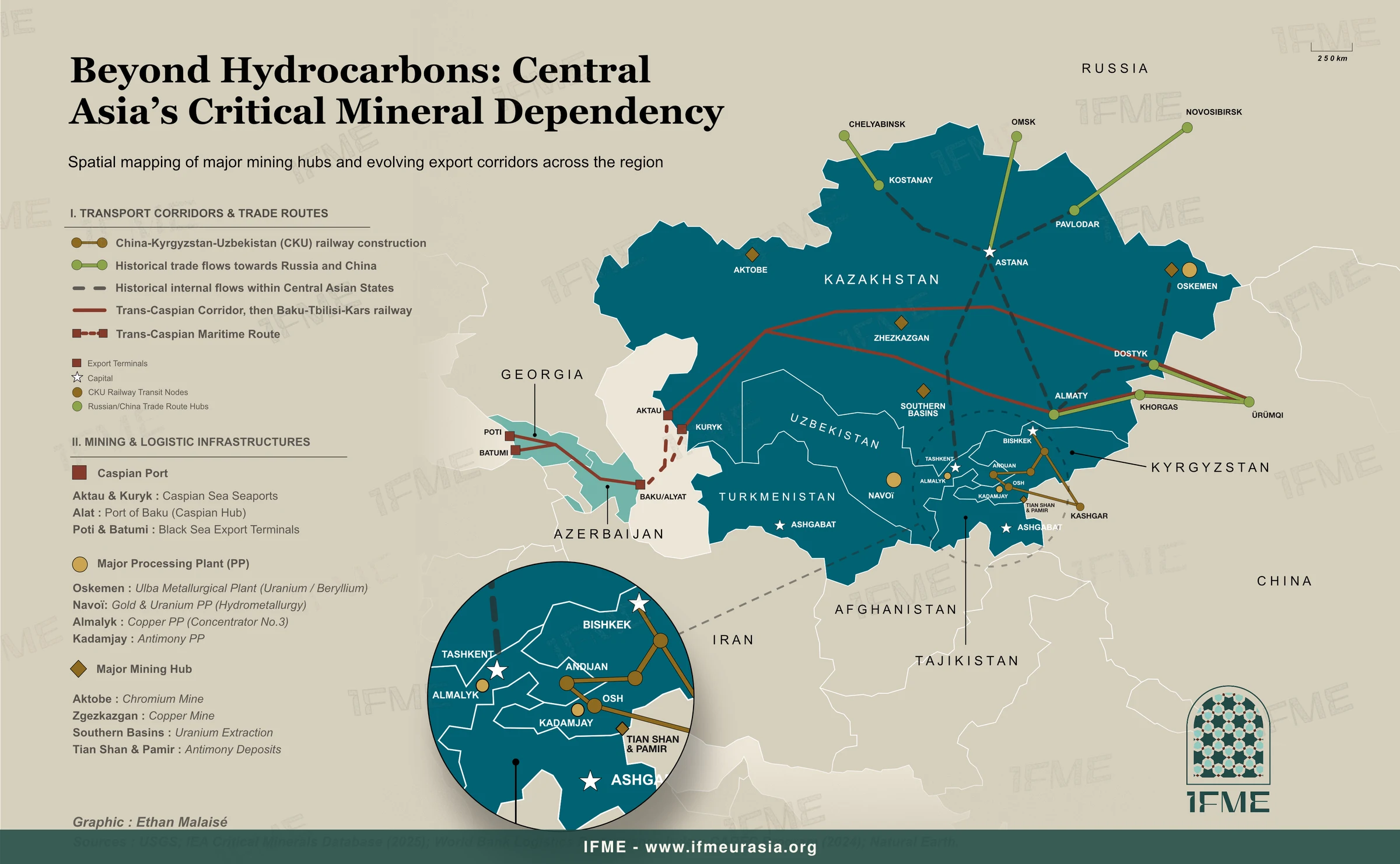
Long viewed through the prism of hydrocarbons, Central Asia has emerged as a central arena for critical minerals. Against an international backdrop, the region’s weight can no longer be measured by its deposits alone. Kazakhstan could export 21 of the 34 critical raw materials listed by the EU. Kyrgyzstan holds the world’s third-largest antimony reserves. Uzbekistan ranks eleventh for copper. Yet the decisive question is less where the resource lies than where it is processed, by which routes it travels and who gains power from it.
The map of resources follows the map of accessibility. Kazakhstan concentrates most of the industrial capacity inherited from the Soviet era: the Altai mining basin around Oskemen, the copper deposits of Zhezkazgan and the chromium of the Aktobé region. Its uranium, mined mainly by in-situ leaching in the southern basins, has made it the world’s leading producer since 2009. Following a comparable pattern, Uzbekistan is organised around the Kyzylkum desert. The Navoï combine is oriented towards gold and now uranium, of which the country is the sixth-largest producer. Copper is concentrated around Almalyk. Further east, the antimony of the Tian Shan and the Pamir remains harder to exploit. Because of isolation and the state of infrastructure, Tajikistan part advances more slowly than its neighbours. Turkmenistan, for its part, remains structured around its hydrocarbons.
Landlocked, these states cannot send to the Critical Minerals market without crossing a neighbouring country. Kazakhstan is the largest landlocked country in the world and Uzbekistan one of only two doubly landlocked states. Flows have historically run north through the Russian network and east towards China.
In this way, as early as April 1904, Halford J. Mackinder described in “The Geographical Pivot of History”, the interior of Eurasia as inaccessible to ships, once open to nomadic horsemen and about to be covered by railways. More than a century later, rail still decides who can reach it.
« As we consider this rapid review of the broader currents of history, does not a certain persistence of geographical relationship become evident? Is not the pivot region (...) that vast area of Euro-Asia which is inaccessible to ships, but in antiquity lay open to the horse-riding nomads, and is to-day about to be covered with a network of railways? There have been and are here the conditions of a mobility (...) of a far-reaching and yet limited character. »
Therefore, two axes now frame diversification. The China–Kyrgyzstan–Uzbekistan (CKU) railway, under construction, would open a southern route across the Tian Shan, but raises different problems. China would bear 51% of its cost, with Kyrgyzstan and Uzbekistan sharing the rest. Estimated at $8 billion, it is now expected to cost far more than first planned. Its gauge also changes at Makmal, where a transhipment hub is planned.
The Trans-Caspian “Middle Corridor” links the eastern shore of the Caspian to Baku and then to the South Caucasus. The United States and the five Central Asian states (C5+1) have jointly called for its extension, yet it remains limited by transhipment capacity. The Middle Corridor relies on the Kazakh ports of Aktau and Kuryk, on Alat in Azerbaijan and on Georgia’s Black Sea ports. Poti and Batumi are already close to their capacity limits. The falling Caspian had already reduced ferry traffic between Baku and Kuryk. Thus, neither removes dependence, both spread it.
Unevenly, processing capacity is emerging. In Oskemen, the Ulba Metallurgical Plant already produces beryllium, tantalum and niobium alongside nuclear fuel. In Almalyk, Copper Processing Plant No. 3, launched in March 2026, is designed to treat 60 million tonnes of ore a year and to yield about 900,000 tonnes of copper concentrate. A $2.5 billion copper smelter has also been announced on the same site (IAE). In Navoï, several hydrometallurgical plants are being expanded.
Therefore, having minerals is only the first step. Processing plants and reliable transport routes will shape how much value Central Asia can gain from them.