
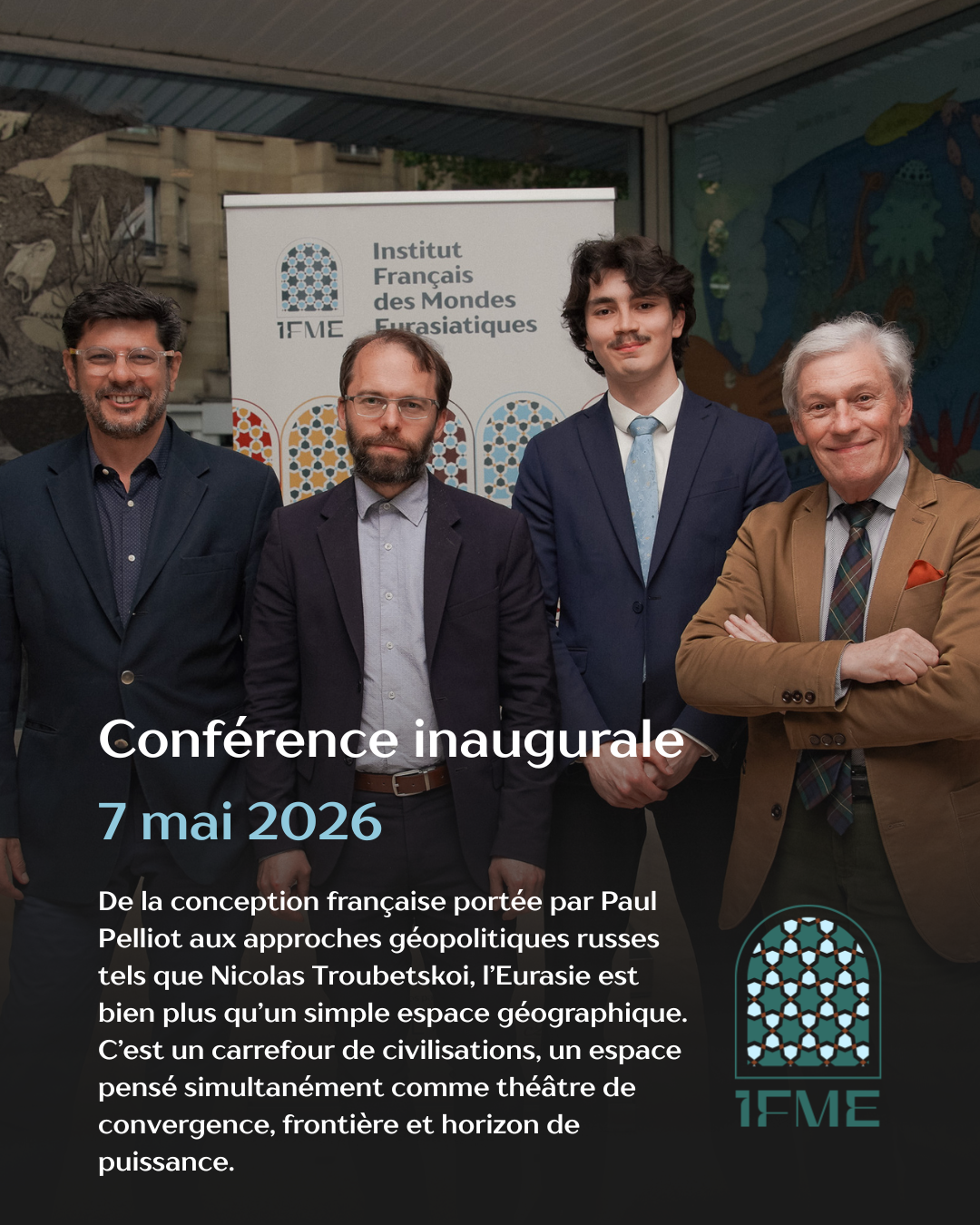
Conférence inaugurale - L’Eurasie : un espace de contacts entre représentations savantes et enjeux de puissance
Etkinlik hakkında
Rapor
First of all, it is imperative to clarify what IFME (Institut Français des Mondes Eurasiatiques) covers, as it is not only a space of communication but also of research and analysis on subjects related to the area that Eurasia represents. From Turkey to China and well beyond, Eurasian states lie at the centre of the vast range of topics IFME addresses.
At this inaugural conference, three principal speakers introduced IFME to the world in Paris: Jean-Claude Voisin, Samim Akgönül and David Teurtrie, alongside Ethan Zelko-Yilmaz and Robin Millet of IFME. The first is an Iranologist and founder of the journal Paris-Téhéran. The second is director of the Department of Turkish Studies at the University of Strasbourg. The third is director of the French Observatory of the BRICS and a lecturer at ICES. Together they brought their respective fields of expertise to the audience of the IFME Inaugural Conference on 7 May 2026.
What does Eurasia consist of?
Before entering into deeper discussion, the speakers considered what Eurasia means. From the French notion embodied by Paul Pelliot to the Russian approaches, Eurasia is a polysemic concept that sits at the crossroads of competing intellectual and political appropriations.
Beyond its literal and geographical sense, Eurasia has long been a region whose strategic importance has never ceased to provoke disputes among its bordering powers. Historically the area has been a ground for battle precisely because of its pivotal role in the world. The Iranian margins of Khorassan and the contact zones between the Iranian, Turko-Mongol and Russian worlds alike show how contested the region was, and remains.
David Teurtrie on Russian Eurasianism
One of the first topics discussed was Russian Eurasianism. David Teurtrie opened on this movement, founded in the 1920s and 1930s by Nicolaï Troubetskoï, a linguist who was also part of the Russian intelligence service. Its first wave was the work of White Russians, when the Bolshevik Revolution took place and Tsarist Russia crumbled. A second wave followed in the 1980s and 1990s with the Soviet Neo-Eurasianists. From the movement’s inception, the Eurasianists understood that Russia would never again return to monarchy. They therefore sought to imagine the country’s future through a new ideological lens: a Russia without the Bolsheviks.
Towards the 1940s and 1950s, Russian Eurasianism was in decline. The figure who remained most faithful to the movement was Petr Savitsky, a more liberal and occidentalist representative, who formed a bridge between classical Eurasianism and the Neo-Soviet Eurasianism founded towards the end of the twentieth century. Doctrinally, Troubetskoï held that Russia had to be protected from European culture and its vision of the world.
The main theses of Russian Eurasianism were born of revolution and the First World War. For the Eurasianists, Russia began to decline when Peter the Great imposed Westernisation. The Bolshevik Revolution then accelerated this Europeanisation, destroyed the national identity and its spiritual foundations, introduced materialist ideas and reduced Russia to a European province. Convinced that Russia possessed a rich and diverse cultural heritage, they came to regard Eurasia as the frontier of the Russian Empire. In this sense the Eurasianists claimed that Russia was not part of Eurasia but a country lying between Europe and Asia.
More recently, however, Putin has invoked Eurasianism differently, as a greater Eurasia surrounding the Eurasia of the Russian Eurasianists, one that brings China and India together geographically.
Samim Akgönül on Turkish Eurasianism
Another principal topic was Turkish Eurasianism, a distinctive variety owing to Turkey’s geographic position astride two continents. Turkey is thus not only a bridge between East and West, between Asia and Europe, but also the very embodiment of the tensions inherent in Eurasianism at large: between imperial imaginary and anti-imperialist discourse, between ethnic and civilisational debate.
Although Troubetskoï wrote his Eurasianist manifesto in Istanbul, Turkish Eurasianism became a movement only decades later. In the 1990s, Avrasya Seçeneği (The Eurasian Choice) by Doğu Perinçek appeared. The ideas surrounding Eurasianism had already been discussed in the early twentieth century, alongside Turkish nationalism, but the term itself had not yet been defined.
Turkish Eurasianism became a movement later than other branches for reasons rooted in the country’s history. For centuries the Ottoman Empire pursued a foreign policy oriented towards the West. The geopolitics of the Cold War then made neutrality impossible, which is why Turkey joined NATO in 1952 and, in doing so, cast its lot with the West. Finally, in the 1980s, thanks to the poet and political activist Attilâ İlhan, discussion of Eurasianist ideas began to circulate in Turkey as well.
It is also worth recalling that Turkish Eurasianism was not a direct product of Troubetskoï’s ideas but rather of Dugin’s. Thanks to the latter, author of The Foundations of Geopolitics: The Geopolitical Future of Russia, published in 1997, Eurasianist ideas circulated more widely still.
In Turkey specifically, Eurasianism has passed through three waves. The first, which Alican Tayla terms ‘State Eurasianism’, predates the coining of the term and amounted to an attempt to pave the way towards a more democratic, Western-oriented Turkey. The second, in the 2000s, placed decisive weight on the Turkish army. The third dates to 2013, following events such as the criminalisation and suppression of the Taksim Gezi activists. Turkish Eurasianism is therefore more than geographical; it is a genuine strategic doctrine whose content adapts to the priorities of the moment.
Jean-Claude Voisin on the Central Role of Iran in Eurasia
Owing to its pivotal geographic position, between the Caspian Sea and the Persian Gulf, Iran has been inhabited for three thousand years. Countless ideas and concepts have accordingly circulated through the country over the centuries. As a crossroads of cultures, Iran has borne the imprint of the artists and philosophers who passed through and shaped it.
One of the defining features of Iran is nomadism. Successive migratory movements have shaped everyday life in numerous ways, from the habit of taking meals seated on the floor to the ubiquity of the picnic. Conquerors, too, form a key part of the country’s story, for the many techniques they brought with them, among them the use of mortar in construction.
Water is another crucial dimension. The control of water began in Mesopotamia, where, around 1000 BC, the populations of the region faced a drying climate. To irrigate their crops and their land they had to dig into the earth, and the irrigation systems devised in Mesopotamia were subsequently adopted by the Iranians.
In conclusion, foreign influences have shaped every facet of Iran. Its people have absorbed centuries of cultures coming and going, each leaving something of itself behind. Many Iranian politicians know the West intimately, its philosophy, its limits and its shortcomings, while still holding to Eastern thought, their own ways of reasoning and their taarof.
Diğer etkinlikler
- Paris Peace ForumPalais de Chaillot (Trocadéro)Etkinliği gör
- L'islam en Asie centrale (Garnelle x IFME 1/4) Centre culturel des Garnelles, 6 rue Jean Nicot, 75007 ParisEtkinliği gör
- Fuir, transiter, s'installer : la guerre en Ukraine et la recomposition des mobilités en Asie centraleUniversité Catholique de Lyon UCLY (amphithéâtre Merieux, Campus Saint-Paul)Etkinliği gör