
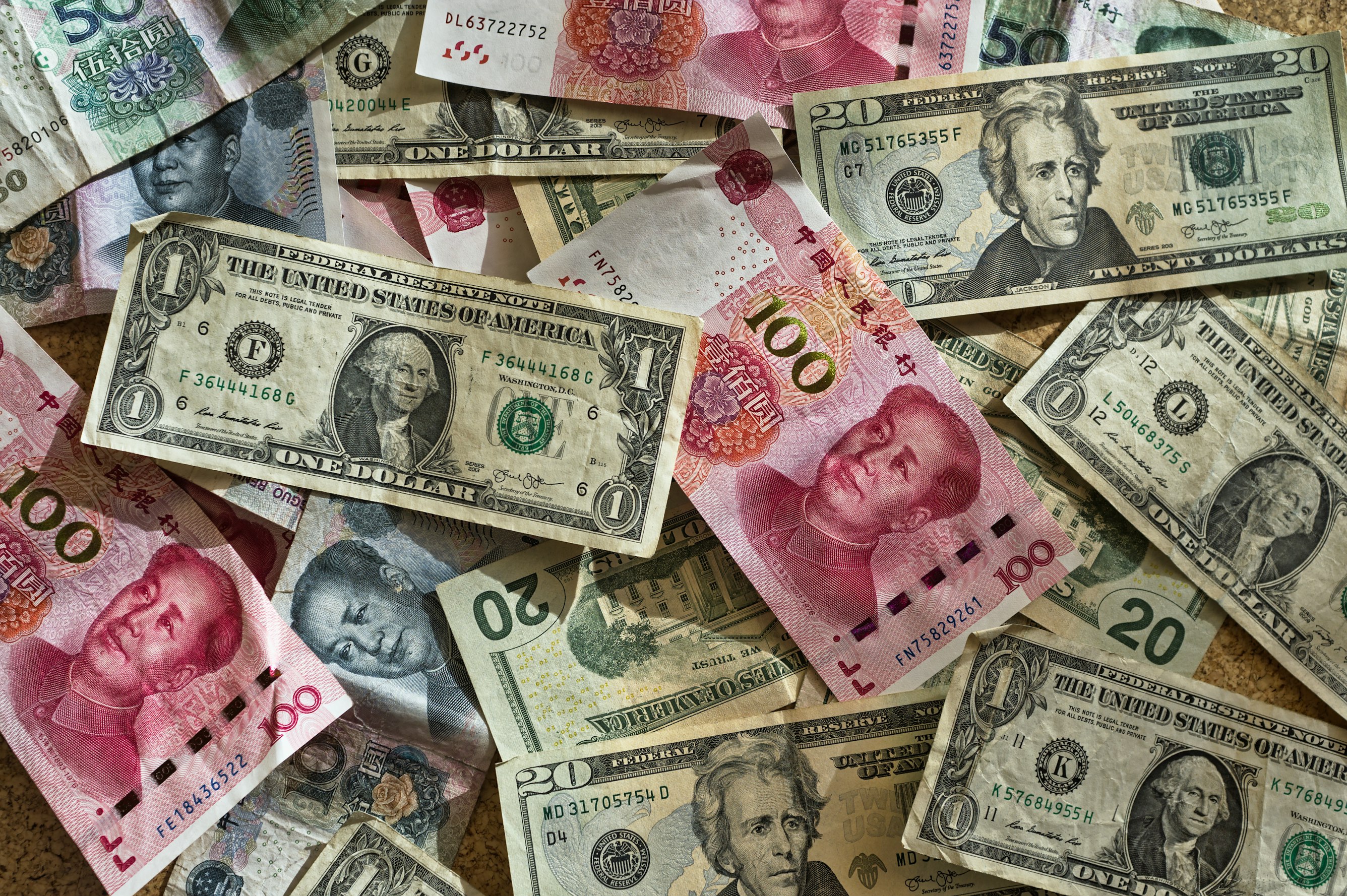
On the 7th of September 2026, Kazakhstan’s Ministry of Finance placed 6.6 billion CNY of panda bonds in China’s interbank market, in a three-year tranche at 1.82% and a five-year tranche at 1.95%. Zhengquan Shibao (Securities Times), citing the lead underwriter, called the transaction the largest renminbi bond yet issued by a Central Asian borrower.[1] Five months earlier, Chinese Vice Premier Ding Xuexiang had attended the groundbreaking of the fourth phase of Galkynyş, Turkmenistan’s largest gas field, a 5.1 billion USD project financed from domestic funds.[2] Turkmen gas reaches China under a 2006 intergovernmental agreement that prices it against comparable international markets and requires payment entirely in U.S. dollars.[3]
Both deals come out of the same relationship with Beijing. One is yuan debt while the other is a gas project financed at home and tied to a trade settled in dollars. Yuan finance in the region might be read as a step out of the dollar system, sped up by the sanctions imposed on Russia since 2022. However, this overgeneralizes the situation as Central Asia complicates that reading. The region trades heavily with China, yet the dollar still dominates foreign currency trading in Kazakhstan, its largest economy. That combination makes Central Asia a useful test for the wider debate on global financial fragmentation.
Central Asia is taken here to mean the five former Soviet republics of Kazakhstan, Kyrgyzstan, Tajikistan, Turkmenistan and Uzbekistan. China means the People’s Republic of China (PRC), including the offshore renminbi market in Hong Kong. The period this article covers opens with the 2006 gas agreement, which fixed the dollar as the currency of Turkmen gas sales to China, and the first China Development Bank (CDB) loans to Turkmenistan in 2009. It runs through the reorganisation of regional payments after 2022 to the first renminbi bond by a Central Asian state issuer in September 2025 and Kazakhstan’s new swap agreement with the PRC in July 2026.
Over those two decades, the routes by which Chinese finance reaches Central Asia have been split by both currency and instrument. Since September 2025, Kazakh issuers have placed 23.45 billion CNY in panda and dim sum bonds (yuan bonds sold inside mainland China and offshore, respectively, as the next section explains). Alongside these issues abroad, a domestic yuan bond segment has grown on the Astana International Exchange (AIX), the exchange of Kazakhstan’s Astana International Financial Centre. Taken together, they are building a renminbi channel on the edge of a financial system that the dollar still dominates, within limits set by Western sanctions enforcement against regional banks and payment intermediaries and by the reluctance of Chinese banks to handle payments that could expose them to U.S. sanctions. Turkmenistan, the largest Central Asian supplier of gas to China, runs on a different design.[4] Its gas is priced and paid in dollars, its Chinese loans were repaid from gas receipts and its new investment is self-financed. The two cases here mark the ends of the regional record: Kazakhstan is the only Central Asian sovereign to have issued renminbi bonds, and Turkmenistan is the only one of the five republics that has had none of the three main renminbi links:a swap line with the People’s Bank of China (PBOC), a direct participant in China’s Cross-Border Interbank Payment System (CIPS), the main system for cross-border renminbi payments, or a renminbi bond. Kyrgyzstan, for instance, has never held a swap line either, but its banks connect directly to CIPS and a Kyrgyz company has issued yuan bonds. Read side by side, they show that the currency of a financing route has legal and political consequences as well. It decides which institutions carry sanctions exposure and how far each government ties its fiscal planning to Chinese markets.
From a Debut Dim Sum to a Yuan Curve
The renminbi trades in two separate markets. CNY is the onshore yuan, traded inside mainland China under capital controls, and the PBOC lets it move only within a band around a daily reference rate. CNH is the offshore yuan, traded mainly in Hong Kong since 2010, and it floats more freely. It is the same currency, but the two usually trade at slightly different exchange rates because money cannot move freely between them. Officially, CNY is the only ISO code for both; CNH is a market label.[5]
Panda bonds are yuan bonds sold inside mainland China by issuers registered outside it, and they are denominated in onshore CNY. Issuers include foreign governments, multilateral development banks, financial institutions and companies, along with the offshore arms of some Chinese groups. Most trade on China’s interbank bond market, with the stock exchanges in a supporting role, and issuers register with Chinese regulators. The International Finance Corporation and the Asian Development Bank issued the first ones in 2005.[6]
Dim sum bonds are yuan bonds sold outside mainland China, mostly in Hong Kong, and they are denominated in offshore CNH. Chinese issuers dominate this market, from the Ministry of Finance and local governments to banks and companies, and foreign borrowers have joined them. The bonds follow Hong Kong and international issuance practices and are sold mainly to offshore investors. The China Development Bank issued the first one in 2007.[7] Table 1 compares the two.
Table 1: Panda and dim sum bonds compared
Panda bond | Dim sum bond | |
|---|---|---|
Where issued | Mainland China, mainly the interbank bond market | Offshore, mainly Hong Kong |
Currency | CNY (onshore) | CNH (offshore) |
Typical issuers | Foreign governments, development banks, financial institutions and companies, plus offshore arms of some Chinese groups | Mainly Chinese issuers, from the Ministry of Finance to banks and companies, plus foreign borrowers |
Main investors | Chinese banks, insurers and funds; foreign investors through Northbound Bond Connect | Mainly offshore institutional investors; mainland investors through Southbound Bond Connect |
Rules | Registration with Chinese regulators and onshore disclosure | Hong Kong and international practice; Chinese issuers also file with the National Development and Reform Commission |
Source: Lianhe Ratings Global, “Panda Bonds or Dim Sum Bonds?” (note 6); currency labels from Cheung and Rime (note 5).
Why would an issuer pick one over the other? A panda bond reaches China’s large domestic investor base, and it is a natural way to fund operations inside China. Panda issuance has also picked up since 2022, largely because Chinese interest rates fell below U.S. rates. The trade-off is onshore registration and disclosure. A dim sum bond is lighter on regulation and follows familiar international practice. However, the offshore yuan pool behind it is far shallower, so liquidity is thinner and prices can swing as the supply of offshore yuan changes.[8]
Kazakh issuers went from a first offshore renminbi note to a yuan yield curve in twelve months. In September 2025, the Development Bank of Kazakhstan (DBK) issued three-year notes of 2 billion CNH at 3.35% in Hong Kong; Industrial Bank, one of its joint global coordinators, described the deal as the first renminbi bond publicly offered and listed by a Kazakh or Central Asian issuer.[9] KazMunayGas (KMG), the national oil and gas company, followed in October with a five-year dim sum bond of 1.25 billion CNH at 2.95%.[10] In April 2026, the sovereign wealth fund Samruk-Kazyna became the first Central Asian issuer to get a foothold in China’s onshore panda market, with 3 billion CNY of three-year bonds at 2.18%.[11] The Republic followed in May with 3.4 billion CNY at 1.90%.[12] By September 2026, KMG and DBK had each placed ten-year renminbi notes and the Ministry of Finance had added a five-year tranche, which gave Kazakh issuers renminbi reference costs at three, five and ten years (Table 2).[13]
Table 2: Renminbi-denominated bonds by Kazakh issuers, September 2025 to September 2026
Issuer and instrument | Issued | Amount (billion yuan) | Tenor | Coupon or yield (%) |
|---|---|---|---|---|
DBK, dim sum | Sep 2025 | 2.00 | 3 years | 3.35 |
KMG, dim sum | Oct 2025 | 1.25 | 5 years | 2.95 |
Samruk-Kazyna, panda | Apr 2026 | 3.00 | 3 years | 2.18 |
Republic of Kazakhstan, panda | May 2026 | 3.40 | 3 years | 1.90 |
KMG, dim sum | Sep 2026 | 1.50 | 5 years | 2.30 |
KMG, dim sum | Sep 2026 | 2.00 | 10 years | 2.80 |
Republic of Kazakhstan, panda | Sep 2026 | 5.00 | 3 years | 1.82 |
Republic of Kazakhstan, panda | Sep 2026 | 1.60 | 5 years | 1.95 |
DBK, dim sum | Sep 2026 | 3.70 | 5 and 10 years | 2.25 and 2.75 |
Total | 23.45 |
Source: compiled from the disclosures cited in notes 1 and 9 to 13. The total is the author’s arithmetic.
China International Capital Corporation (CICC) led the September sovereign issue, with a syndicate that included the Export-Import Bank of China, a policy bank, alongside China Construction Bank, the Industrial and Commercial Bank of China (ICBC) and Bank of China.[14] China Chengxin International (CCXI) rated the Samruk-Kazyna panda AAA, and China Lianhe Credit Rating gave the Republic and its debut bond the same grade.[15] Kazakh panda issuers therefore come into the Chinese market through its largest state financial institutions and on its domestic rating scale. A dollar eurobond, a bond sold to international investors outside the issuer’s home market, creates no such tie to Chinese policy institutions.
A domestic yuan segment has also grown on AIX, where, according to the Astana International Financial Centre, 22 yuan debt placements worth more than 24.8 billion CNY had been made by September 2026, including listings of panda and dim sum bonds placed abroad.[16] Samruk-Kazyna placed 3 billion CNY of five-year yuan bonds on the 10th of July 2026 at 2.09%, and on the same day, Kcell and KT-Telecom, both subsidiaries of Kazakhtelecom, paid 4.20 to 4.50% at the same tenor, in what the Kazakh news outlet Kursiv calls an internal capital market within the quasi-state sector, Kazakhstan’s state-owned and state-controlled companies.[17] That puts more than two hundred basis points, or two percentage points, between issuers borrowing on the same day at the same tenor, which suggests that each issuer’s own credit standing weighs on its borrowing cost as much as market conditions do. Outside Kazakhstan, the record is thin. A Kyrgyz company, PlanDeM, placed a first tranche of 370 million CNY in green bonds on AIX in December 2024, and Uzbekneftegaz discussed panda issuance with Bank of China in June 2026 without announcing a transaction.[18] No Tajik, Turkmen or Uzbek renminbi bond is on record.
Kazinform, Kazakhstan’s national news agency, compared the Ministry of Finance’s 1.90% debut panda with the 4.412% on a five-year dollar eurobond placed in October 2025. Samruk-Kazyna told Kazinform that most of its projects use Chinese contractors, which reduces the need to convert, and that it manages the remaining currency risk with instruments that include currency swaps.[19] No issuer has disclosed whether its proceeds were converted into tenge (Kazakhstan’s national currency) or dollars, or what the bonds cost once swapped.
Independent analysts qualify the savings. Anton Tabakh and Kirill Lysenko of the rating agency Expert RA note that the yuan rose 9% against the dollar after April 2025, which raises the cost for borrowers without yuan revenue.[20] Yoan Raih and Guiliu Luo of the Finance for Development Lab argue that the apparent yield advantage narrows considerably once hedging and credit-guarantee costs are factored in, while Alicia García-Herrero of Natixis notes that deeper integration also ties repayment and refinancing to the yuan’s trajectory and to Chinese policy.[21] Renmin Ribao (People’s Daily) claims a cost advantage even after currency swap expenses.[22] Kazakhstan is still a small borrower in this market. Panda issuance as a whole passed 160 billion CNY in the first half of 2026 alone, and the two Kazakh pandas of that half, 6.4 billion CNY together, come to about 4% of that total.[23]
Rails Before Bonds
The bonds rest on payment infrastructure that is younger and less continuous than the issuance record suggests. A currency swap line, the first of these rails, lets two central banks exchange each other’s currencies up to an agreed ceiling. The PBOC’s chronology shows that Kazakhstan’s swap line with China opened on the 13th of June 2011 at 7 billion CNY, then equivalent to 150 billion KZT, and was renewed at the same yuan amount on the 14th of December 2014, at 200 billion KZT, and on the 28th of May 2018, at 350 billion KZT.[24] Kazakhstan does not appear in the PBOC’s list of 32 swap agreements as of September 2025, and the date on which the 2018 line lapsed is not documented.[25] Uzbekistan (2011) and Tajikistan (2015) each held a single line, and the PBOC’s chronology records no renewal of either; Kyrgyzstan and Turkmenistan never held one.[26] In late July 2026, the National Bank of Kazakhstan (NBK) signed a new three-year agreement without stating an amount, while Reuters reported a ceiling of 7 billion CNY or 525 billion KZT.[27] If that figure holds, the yuan ceiling has not moved since 2011, and the climb in its tenge equivalent from 150 billion to 525 billion KZT simply tracks the fall of the tenge.
The NBK release also shows where the weight of the 2026 package fell. In the release, yuanbond issuance by Kazakhstan appears only as one of four topics listed in a single sentence about talks with Chinese regulators, while the payment items each get a paragraph of their own: a pilot for settlements in the digital tenge and the digital yuan, the integration of QR payments with UnionPay International by the end of the year and next steps under a memorandum of understanding among the NBK, its National Payment Corporation (the operator of Kazakhstan’s interbank payment systems) and CIPS.[28] Kazakhstan issued both sovereign pandas while its central bank was rebuilding the swap and payment rails beneath them, which suggests that the bonds are one piece of a wider settlement channel.
Access to that channel looks different in each country. In Kazakhstan, it runs through Chinese-owned entities. ICBC (Almaty) has been the region’s only PBOC-designated renminbi clearing bank, appointed to settle renminbi payments locally, since September 2022. The Kazakh direct participants in CIPS, which connect to the system without going through another bank, are the clearing bank of ICBC, Bank of China Kazakhstan and the Astana branch of China Construction Bank.[29] Kyrgyzstan relies on its own state banks. Eldik Bank is already a direct participant and has begun connecting other Kyrgyz banks, and ABank signed for direct status in September 2026.[30] In Uzbekistan, Uznatsbank, the country’s largest systemically important bank, signed an agreement with CIPS on direct connection in Hong Kong on the 9th of September 2026 and intends to act as a hub for other Uzbek banks.[31] No Tajik or Turkmen bank appears among the direct participants in CIPS.
The flows through these rails are growing from a low base. The PBOC reports renminbi receipts and payments between China and the five republics of 79.06 billion CNY in 2024, up 53.9%, and a renminbi share of goods-trade settlement with China of about 25% for Kazakhstan, Kyrgyzstan and Tajikistan, rising to 30% in the first half of 2025. Inside Kazakhstan, the same report puts the yuan at 0.1% of interbank over-the-counter currency trading and 1.5% of interbank currency volume from January to May 2025, against 90.2% and 74.2% for the dollar.[32] A renminbi share of 25 to 30% in trade with China, compared with a yuan share of 1.5% or less on these market measures, suggests that the yuan in that trade comes through Chinese bank channels and offshore liquidity and largely bypasses Kazakhstan’s domestic financial system.
Enforcement Follows the Workaround
The payment side of the relationship, where Russia-linked trade passes through the region, took shape under pressure from two directions. The first came from Chinese banks. In February 2024, RBC reported that ICBC, China Construction Bank and Bank of China had stopped accepting payments from sanctioned Russian banks, citing internal policy.[33] By August 2024, Aleksei Razumovskii, commercial director of the company Impaya Rus, told RBC that more than 98% of Chinese banks refused direct transactions from Russia.[34]
The second came from Western sanctions enforcement, which followed the trade into the region. On the 15th of January 2025, the U.S. Department of the Treasury designated Keremet Bank of Kyrgyzstan, adding it to the U.S. sanctions list. It acted under Executive Order 14024, the main legal basis for U.S. sanctions on Russia, as amended by Executive Order 14114, which extended those sanctions to foreign banks that deal with Russia’s military-industrial base. The Treasury stated that the bank’s officials had worked with Russia’s Promsvyazbank since at least the summer of 2024 on a scheme to make cross-border transfers on its behalf, and that the Kyrgyz Ministry of Finance had sold a controlling stake in the bank that year to a firm “strongly linked to a Russian oligarch with ties to the Russian government.” The same release also sanctioned nine China-based regional clearing platforms, payment intermediaries that the Treasury tied to the same scheme, so a single action covered Chinese and Central Asian intermediaries.[35]
The European Union (EU) widened its sanctions from individual banks to the payment channels themselves. Its nineteenth sanctions package, adopted on the 23rd of October 2025, banned transactions with Kyrgyzstan’s Tolubay and Eurasian Savings Bank and with three Tajik banks from the 12th of November 2025, and with VTB Bank (Kazakhstan) from the 2nd of December 2025.[36] The twentieth package of the 23rd of April 2026 identified Kyrgyzstan as a jurisdiction where the risk of circumvention is “systematic and persistent.”[37] Its recitals record that, in the first ten months of 2025, EU exports of common high-priority items to Kyrgyzstan had run almost 800% above their pre-war level, and Kyrgyz exports of the same items to Russia had run 1,200% above it. It banned transactions with Keremet and Capital Bank of Central Asia and opened a new list for non-bank operators that settle through netting, set-off or reconciliation. The same act lifted sanctions on two Chinese banks and the three Tajik banks, which, according to the regulation, had taken measures to close loopholes.[38] The twenty-first package of the 23rd of July 2026 added Kyrgyzstan’s Eco-Islamic Bank from the 13th of August 2026.[39] On the 1st of October 2026, the U.S. Financial Crimes Enforcement Network (FinCEN) described Kyrgyzstan as central to the A7 network, which it calls a sanctions evasion and money laundering service with ties to Russia, running through companies jointly owned by the Russian state bank Promsvyazbank and the U.S.-sanctioned businessman Ilan Shor. FinCEN reported at least 179.1 billion USD in transactions between February 2025 and June 2026 in A7A5, a stablecoin, or digital token, issued by a Kyrgyz company and advertised as backed by ruble deposits at Promsvyazbank.[40]
Governments in the region have absorbed this pressure differently. Kyrgyzstan has started policing sanctions risk itself, acting against domestic companies that could draw Western sanctions onto its banks. Bakyt Sydykov, the Minister of Economy and Commerce, now doubles as the President’s special representative on sanctions policy, and in June 2026, he reported that the state banks Eldik and ABank had ended relations with more than 130 companies since the 1st of May 2026.[41] In August, a meeting he chaired moved to have nineteen more companies liquidated over sanctions risks.[42] Kazakhstan’s financial regulator said in October 2025 that the EU’s sanctions on VTB Bank (Kazakhstan) did not affect the stability of the country’s financial system.[43] In Uzbekistan, exposure runs through remittances, which reached 18.9 billion USD in 2025: Asakabank suspended Zolotaya Korona transfers, citing technical work, after the twenty-first package placed the operator of Zolotaya Korona, a Russian money transfer service, under sanctions.[44]
On this record, Beijing has acted only when its own institutions were themselves sanctioned. Its Ministry of Foreign Affairs restates China’s opposition to long-arm jurisdiction without a basis in international law or authorisation by the United Nations Security Council.[45] The Ministry of Commerce (MOFCOM), however, answered the EU’s listing of two Chinese banks in July 2025 with countermeasures against two Lithuanian banks in August and withdrew those countermeasures with effect from the 24th of April 2026, the day after Brussels lifted its sanctions on the Chinese banks.[46] No Chinese official statement on record addresses how Chinese banks screen such payments. The refusals since 2024 point to banks managing their own exposure to secondary sanctions, under which the United States can cut foreign banks off from the U.S. financial system for dealing with sanctioned Russian parties. The Chinese state, for its part, limits itself to reciprocity.
None of this enforcement has touched the renminbi bond issuers. The sanctions record names Kyrgyz commercial banks, non-bank settlement operators, the A7 token network and the Kazakh subsidiary of a Russian bank; the bond record names an investment-grade sovereign, its wealth fund, its development bank and its national oil company, and China’s largest state banks arranged the panda deals among them.[47] For Russia-linked trade, a renminbi channel offers no shelter. The gatekeeper simply changes from a U.S. correspondent bank, which clears dollar payments for foreign banks, to a Chinese state bank, which screens out Russia-linked payments to protect itself from the same U.S. sanctions risk.
Turkmenistan: A Dollar-Priced Design
Among the five republics, only Turkmenistan has none of this machinery: no renminbi bond, no swap line and no direct participant in CIPS. Its gas relationship with China rests on a treaty text that settles the currency question in advance. Under Article 2 of the General Agreement signed in Beijing on the 3rd of April 2006, China undertook to buy thirty billion cubic meters (bcm) of gas a year at the Turkmen border for thirty years. Article 4 sets the price based on comparable international market prices, “完全用美元支付” (paid entirely in U.S. dollars).[48] MOFCOM’s 2025 guide for Chinese investors in Turkmenistan spells out the consequences. The two states have signed neither a free trade agreement nor a bilateral currency swap, and the renminbi and the manat, Turkmenistan’s currency, are not directly convertible. Chinese companies mostly settle in dollars and cannot use the renminbi for cross-border trade and investment in the country.[49] The PBOC has never held a swap line with Turkmenistan, and no Turkmen bank appears among the direct participants in CIPS. Chinese customs report the trade in dollars: 8.41 billion USD of Turkmen gas in 2025, against 9.57 billion USD in 2024.[50]
The financing followed the same logic. China Development Bank lent Turkmengaz 4 billion USD in June 2009, for seven years at a fixed 4.8426%, and 4.1 billion USD in 2011, for ten years at 4.8855%, under a loan-for-gas framework agreement signed that March. The China National Petroleum Corporation (CNPC) paid for the gas into a collection account at CDB opened on behalf of Turkmengaz, against which the loans were secured. In June 2021, the Turkmen government reported that both loans had been repaid in full.[51] World Bank data shows Turkmen public debt owed to China falling from a peak of 7,329 million USD in 2013 to 76 million USD in 2024, when total external debt stood at 3.32 billion USD, or 5.2% of gross national income. No bondholder debt is recorded for any year from 2009 to 2024.[52]
The fourth phase of Galkynyş, launched in 2026, goes ahead without Chinese state finance. Fitch describes domestic financing of 5.1 billion USD for the project as fully secured, and Eurasianet reports that Beijing is providing no financing and that Ashgabat is paying the entire bill.[53] Chinese companies take part as paid contractors instead: the CNPC engineering subsidiary China Petroleum Engineering and Construction Corporation (CPECC) holds a 4.614 billion USD turnkey contract from CNPC Amu Darya, CNPC’s operating company in Turkmenistan. CNPC thus earns from the project as a contractor, while the money comes from Turkmenistan.[54] Ding Xuexiang’s visit produced a new general agreement on the basic principles of gas cooperation and a cooperation plan for 2026 to 2030; neither has been published with financing terms or volumes.[55] The model now combines Chinese contractors, Turkmen funds and Chinese purchases of the gas, and the 2006 dollar clause remains the last published word on settlement.
Volumes are hard to pin down, and concentration is high. Gurbanguly Berdimuhamedov, the former president who now chairs the Halk Maslahaty (People’s Council), Turkmenistan’s highest representative body, cited about forty bcm a year as a recent average, while Chinese Ambassador Ji Shumin put deliveries in 2025 at about thirty bcm.[56] Dividing the 2025 customs value by the price of just under 290 USD per thousand cubic meters that Interfax reported for the second quarter of 2025 gives roughly 29 bcm, in line with the ambassador’s figure for that year.[57] According to Fitch, China took 88% of Turkmenistan’s gas exports in 2024, although a swap route through Iran began carrying about 120 million cubic meters a month to Türkiye in March 2025.[58] In July 2026, Fitch affirmed Turkmenistan at BB- with a stable outlook, projecting reserves equal to about 46 months of current external payments in 2026 and 2027, the highest coverage among the sovereigns it rates.[59] No eurobond, panda bond or yuan instrument by Turkmenistan is on record. With its Chinese loans repaid and the highest reserve cover among the sovereigns that Fitch rates, Turkmenistan could take a market route if it chose to do so. Whether a gas trade priced in dollars gives it any reason to is still an open question.
Two Designs, One Perimeter
Table 3 sets the two routes side by side.
Table 3: Kazakhstan’s and Turkmenistan’s financing routes with China, as of October 2026
Kazakhstan | Turkmenistan | |
|---|---|---|
Pricing and settlement currency | Renminbi for bond debt service; the dollar dominates domestic currency markets | U.S. dollar under the 2006 General Agreement; renminbi not usable for cross-border trade and investment |
Creditors and investors | Onshore Chinese and offshore investors, through CICC, ICBC, China Construction Bank, Bank of China and the Export-Import Bank of China | China Development Bank loans of 2009 and 2011, secured on gas receipts and repaid by 2021 |
PBOC swap line | New three-year agreement, July 2026 | None at any point |
Clearing and CIPS access | ICBC (Almaty) clearing bank; Chinese-owned direct participants | No CIPS direct participant |
Current financing source | Market issuance in renminbi, alongside dollar eurobonds | Own funds for the fourth phase of Galkynyş |
Main exposure | Currency and refinancing risk; creditor concentration on Chinese markets | Concentration on one buyer and one pipeline system |
Source: compiled from the sources cited in notes 1 to 59.
Both Kazakhstan’s and Turkmenistan’s financing routes run through Beijing, and they differ most in where each one puts its risk. Kazakhstan accepts currency and refinancing risk in return for a wider investor base and a reference curve that its quasi-state companies can use; as García-Herrero observes, that ties part of its refinancing to the path of the yuan.[60] Turkmenistan’s route concentrates sales on one buyer and one pipeline system and has required no market borrowing, and since 2021, the country has carried almost no debt to China. Neither route takes its country out of the dollar system. Kazakhstan borrows in yuan inside a financial system where the dollar still accounts for most foreign currency turnover; Turkmenistan sells its gas for dollars under a treaty that requires it. The comparison also suggests that a large trade with China does not, by itself, build renminbi infrastructure. Turkmenistan sold China 8.41 billion USD of gas in 2025 without a swap line, a clearing bank or a single direct participant in CIPS.
Since 2024, Western enforcement has drawn a perimeter around the region’s payment flows and Kazakhstan’s bond channel stays clear of it, but its payment channel, like Kyrgyzstan’s, sits on the edge. Turkmenistan’s dollar route has so far stayed outside the perimeter altogether. On the evidence of 2025 and 2026, the renminbi is getting a foothold in Central Asia’s new financing routes alongside the dollar, and it is coming in through the channels where issuers can keep their distance from the payments that enforcement now reaches. Over the next year, regional specialists should be watching four things to see whether that holds: a stated size for the new Kazakh swap and the first drawings under it; a first renminbi bond from an Uzbek issuer; any movement on Line D of the Central Asia-China gas pipeline, a planned fourth line that would carry Turkmen gas to China through Uzbekistan, Tajikistan and Kyrgyzstan and that China’s ambassador in Ashgabat says is still under discussion; and how far the EU’s twenty-second sanctions package reaches.[61]
Whatever these four markers show, the two cases already suggest that the currency of a financing route matters for more than its cost. Kazakhstan’s yuan bonds have widened its investor base, but they also tie part of its refinancing to Chinese markets and to the path of the yuan. Turkmenistan’s dollar-priced route has left it with almost no debt to China, but it binds the country’s gas revenue to a single buyer and a single pipeline system. For the wider debate on financial fragmentation, Central Asia suggests that the renminbi is advancing alongside the dollar rather than in its place, and that the shape of that advance depends less on the volume of trade with China than on the choices of issuers, central banks and sanctions authorities.