
Hartë
Members and Observers of The Organization of Turkic States
- Organization of Turkic States
- OTS
- Turkic Countries
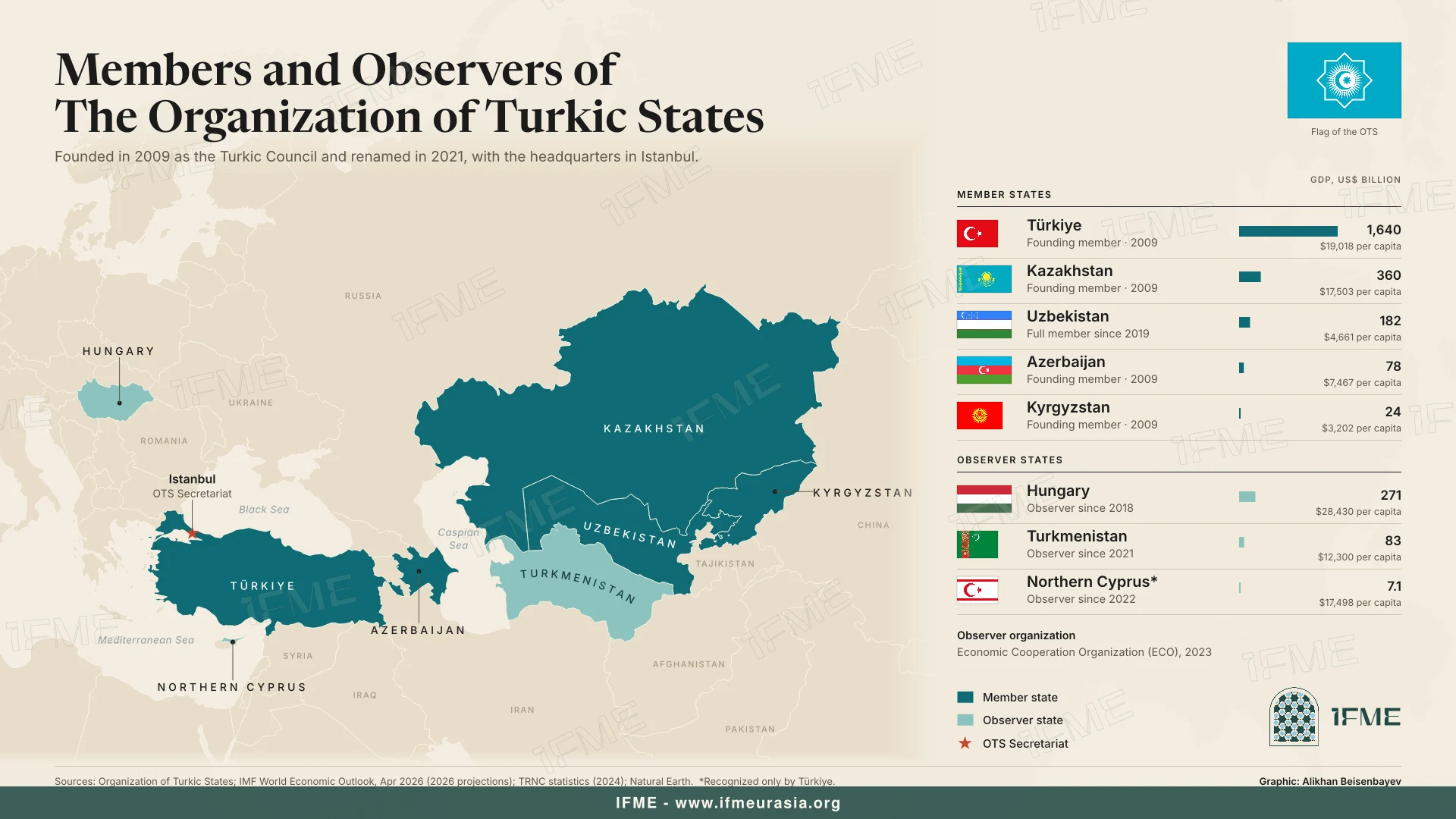
Born out of the rapprochement between Turkic-speaking states following the collapse of the Soviet Union in the 1990s, the Organisation of Turkic States (OTS) reflects its members’ desire to establish a regional framework based on shared linguistic, cultural and historical affinities. Against an international backdrop characterised by geopolitical realignment and the rise of non-Western organisations, the OET appears less as an integration mechanism than as a flexible framework for regional coordination. Its evolution raises questions about the growing role of civilisational solidarity in an international order undergoing transition. Its members include Kazakhstan, Kyrgyzstan, Uzbekistan, Turkey and Azerbaijan, as well as observer states such as Turkmenistan, the Turkish Republic of Northern Cyprus and Hungary.
Although they do not share the same political agenda, a genuine framework has been established over the past thirty years or so, through related organisations such as TURKSOY, which aims to promote Turkic heritage, the World Nomad Games, which aim to be the ‘Olympic Games of the nomads’, and the Kuriltaī, a festival held annually in Hungary, the tradition of which dates back to the earliest nomadic gatherings for the appointment of a leader.
A legacy that the organisation aims to embrace, seeking both to build on the traditions of a civilisation and to find solutions to current problems, such as global warming, security against terrorism and a wide range of partnership areas.
« Therefore The OTS could emerge not only as an emerging regional player, but also as a testing ground for the reshaping of an increasingly post-Western international governance system »