


The analysis focuses on a specific cultic dynamic that developed during the Hellenistic period (336-31 BC), particularly between Asia and Egypt: the association of Dionysus with the royal cult of Hellenistic rulers, with significant consequences for both royal iconography and that of the god himself. In fact, several Hellenistic kings and dynasts identified themselves with Dionysus, both in their iconography and in their onomastics. The aim of this paper is to examine the reasons underlying the differences between the cult of Dionysus in mainland Greece and that of the god in three eastern Hellenistic kingdoms: the Ptolemaic, the Seleucid, and the Attalid dynasty of Pergamon[1]. As will be demonstrated, these differences stem from the political needs of Greco-Eastern rulers, as well as from traditional aspects of the Dionysian cult that lent themselves particularly well to an interpretation in an eastern and dynastic framework. Indeed, the Hellenistic rulers needed to create a royal cult centred on themselves and their family in order to consolidate and legitimize their power. For a number of reasons that will be outlines, Dionysus was the best suited god to this process of propaganda.
The study is based on the analysis of archaeological, iconographic, and epigraphic evidence, as well as ancient literary sources, alongside a critical engagement with a wide body of modern scholarship.
Dionysus in continental Greece
The decipherment of the Linear B tablets by Michael Ventris and John Chadwick, at the beginning of the 1950s, demonstrated the presence of Dionysus in the Hellenic pantheon and culture since the second millennium BC[2]. Unfortunately, the tablets don’t allow us to understand the role of Dionysus in Mycenaean culture. Nevertheless, they have refuted the conjecture according to which the cult of Dionysus would have been of oriental origin, introduced into the Greek pantheon only in the Archaic age (800-480 BC)[3]. This thesis seemed to be corroborated by the almost total absence of the god in the Homeric poems. There Dionysus is mentioned only a few times, in loci predominantly considered by criticism spurious and thus posterior to the eighth century BC: probably, they were not part of the earliest versions of the Iliad[4]. Consequently, the Linear B tablets demonstrated that the almost total exclusion of Dionysus from Homeric epics was a conscious choice of the poet or of the poets of the Homeric poems.
Dionysus occupies a more important role within the Homeric Hymns: two hymns are dedicated to the god, namely I and VII. Whereas Hymn VII recounts the discovery of the vine by the god and his enterprise against the pirates, Hymn I, which is fragmentary celebrates the birth of the god and his assumption on the Olympus. Conceived by Semele, a mortal woman, Dionysus too had to be mortal, but his father Zeus granted him immortality by killing his pregnant mother and giving birth to him from his own thigh. Although immortal, initially Dionysus was devoid of the status of Olympian; he earned this status by acting as a peacemaker between Hera and her son Hephaestus. Thus, as can be understood from the hymn, Dionysus, immortal from birth, earned his assumption onto Olympus thanks to his diplomatic abilities. The hymn therefore brings to light an aspect not to be underestimated, which will always play an important role in his cult: the honours of the celestials are not due a priori to the son of a mortal, but it is necessary that he demonstrate he deserves them through his virtuous behaviour.
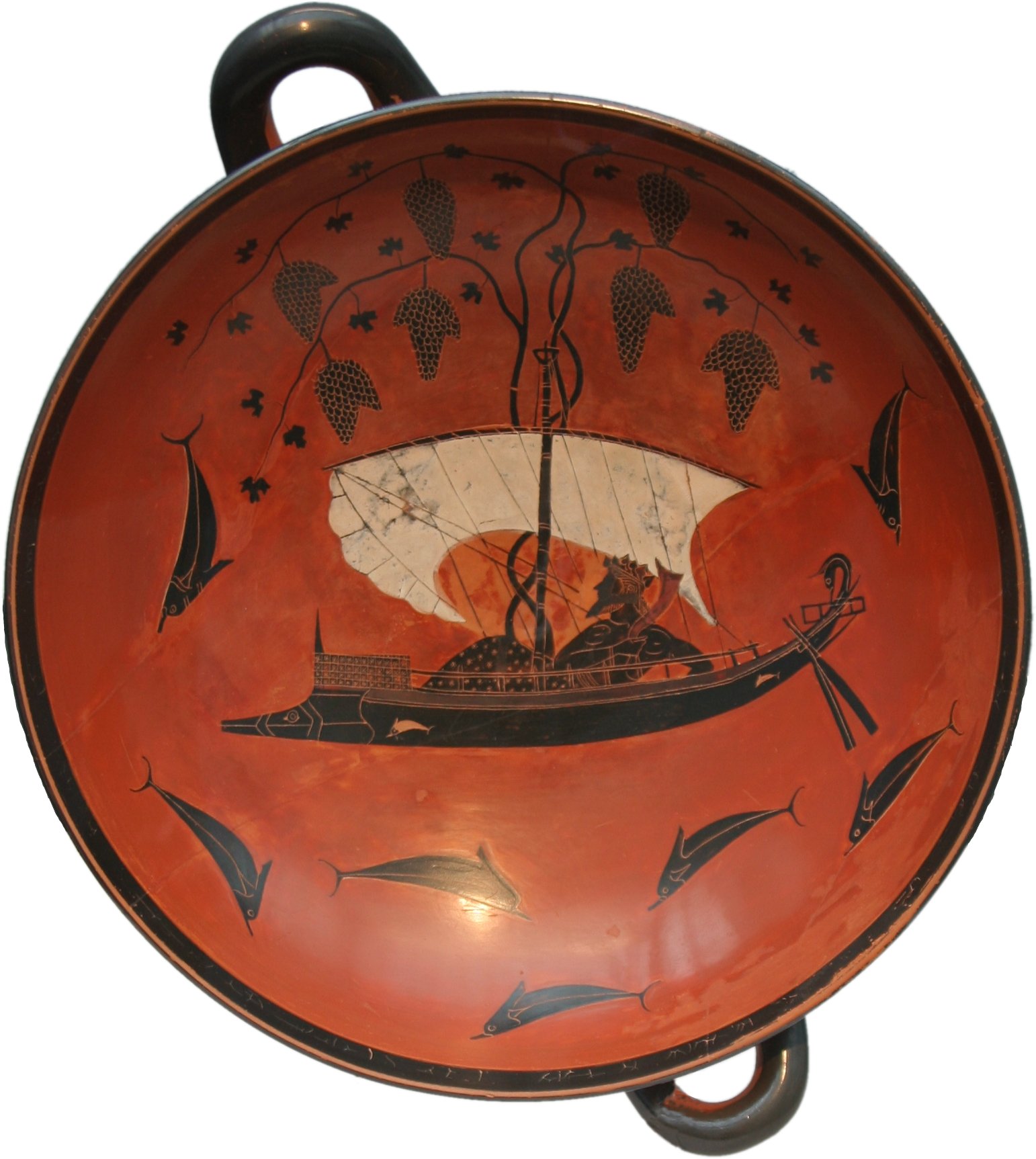
The episode recounted in the Hymn finds a significant correspondence in the history of Dionysiac cults in Greece. Just as in myth the god earns access to Olympus and recognition of the status of “celestial”, so the Dionysiac cults also had to overcome an initial resistance, exercised above all by institutions. Actually, already from the Archaic period the cult of Dionysus was among the most popular in Greece, as is also confirmed by iconography: Dionysus, god of wine, is the protagonist of several vase representations. However, as underlined by Robert Parker, literary and epigraphic sources reveal an initial attempt at opposition, or at least at control, by the civic institutions with respect to Dionysiac cults[5]. The tragedy Bacchae by Euripides represents the most famous literary example that can be identified as a fossil of this resistance: the Theban king Pentheus obstinately refuses to recognize the divine nature of Dionysus, until the latter displays all his powers, which will have disastrous consequences for the obstinate Pentheus. Moreover, already in Homeric Hymn VII Dionysus had shown his prodigious abilities to the pirates who had attacked him, transforming them into dolphins.
Furthermore, the inscription CGRN 78[6] also makes explicit the interdiction of Dionysiac thiasoi within the Thesmophorion of Demeter in the district of the Piraeus at Athens. According to the interpretation of Parker, this epigraph would be a proof of the limits that the polis attempted to place on Dionysiac cults[7]. Indeed, already Eric Dodds maintained that the polis of Miletus «kept Dionysus in a straitjacket», precisely with regard to these attempts at institutional control[8]. Evidently, the cult of Dionysus was not at all forbidden, but certain aspects of it frightened the institutions, which felt obliged to pay attention so that such a cult would not overflow into something politically dangerous. Probably, the most problematic aspects of the cult of Dionysus from the point of view of the institutions were the drunkenness of the female adherents, as well as the irrational and popular nature of the god himself. These aspects risked to distance citizens from the pursuit of civic norms.
Herodotus (IV, 78–80) testifies that even outside Greece the cult of Dionysus was considered controversial: the king of Scythia, Skyles, underwent a revolt of his population, since he had been initiated into the cult of Dionysus Baccheios. The account of Herodotus demonstrates that there were aspects of the Dionysiac cult that frightened even the so-called “barbarian” populations.
Dionysus and Alexander
The historian Arrian, in the Indikà (V, 26, 5), reports a motivational speech delivered by Alexander the Great to his soldiers, when they were tired and skeptical regarding the continuation of the military campaign in India. In order to persuade his men, Alexander suggested to them that they take inspiration from the deeds of Heracles and Dionysus, thanks to which these figures became famous.
The reference to Heracles is not surprising: as Alexander himself declares in his speech, Heracles was considered an ancestor of the Macedonian king; moreover, Alexander was accustomed to identifying himself with the hero also in iconography, which often represented him endowed with the leonté[9]. Moreover, Alexander himself, in the oasis of Siwa, presented himself to the clergy of Thebes of Egypt as the son of Zeus-Ammon: consequently, an identification with Heracles, the most famous and virtuous human son of Zeus, appears natural. However, the reasons for the fortune of Heracles in Alexandrian propaganda are to be identified in certain particular aspects of the myth of the hero. Heracles accomplishes during his life a large number of deeds, which allow him to elevate himself above common men and even above other demigods. Among these deeds, there are journeys and combats at the ends of the world, easily assimilable to Alexander’s expedition in India. Precisely these deeds guarantee him the apotheosis after death: the acquisition of the status of an immortal god. This status is not granted by birth to the sons of mortal women, but it is exceptionally granted by merit to an extremely virtuous mortal.
Also in this case, the homology between the myth of Heracles and the archaeological evidence of his cult is particularly significant: as Emma Stafford demonstrated, Heracles is the only character of Greek mythology to receive hero cults and divine cults, both attested by archaeology[10]. In conclusion, the adoption of Heracles as a model by Alexander is more than justified: the Macedonian king, a mortal man who claimed descent from Zeus, desired to raise himself above other men thanks to the importance of his own deeds. Moreover, as John Boardman observed, also in Athens under the rule of tyrant Pisistratus the cult of Heracles had enjoyed immense success, allowing the ruler to propagandistically identify himself with the hero[11].
Instead, Alexander’s reference to Dionysus appears less obvious. However, as anticipated, the god of wine also had to earn the recognition of his divine honours through prodigious deeds. Dionysus too accomplished deeds from which men could take inspiration, and which could be identified with the warlike adventures and conquests. Furthermore, Arrian himself, again in Book II (in which he epitomizes Megasthenes, a Greco-Indian historian of the fourth century BC), testifies the birth of the myth of Bacchus dominator orientis: Dionysus was in fact considered the first to have conquered and civilized the East. This deed attributed to the god appears almost paradoxical: Dionysus in classical Greece was often regarded as dangerous and “barbarian” (because of his Phrygian origins) and certainly not as a civilizer. The reasons for this metamorphosis are to be identified in the certainly important role played by Alexander, but also in another factor: during the Asian campaign, the Greco-Macedonian soldiers came into contact with Eastern divinities, which were identified with Dionysus because of cultic analogies. This led the Greeks to believe that the god was already known and venerated beyond the Hellenic boundaries. Similarly, the Asian populations incorporated into the Macedonian empire perhaps identified Dionysus with certain divinities of their own pantheon; probably, this increased the popularity of the god in Asia[12].
Dionysus and his parallels in other mythologies
According to Kerbaker, the divinities with which Dionysus was identified are the Iranian god of medicinal plants Haoma and the Indian god of the vine Soma[13]. Actually, Soma is a divinity of the Vedic age (1500-500 BC), thus preceding Alexander’s campaign in India and entirely absent from texts of the Puranic age (400 BC-1000 AC). Nevertheless, Kerbaker hypothesizes that his cult and veneration survived at a popular level even in the Puranic period, allowing the Greeks to come into contact with them[14]. According to Kerbaker, the divinities Haoma, Dionysus, and Soma were nothing other than three different declinations (Iranian, Greek, and Vedic) of a common Indo-European god of nature[15]. Much more recently, Sergent proposed to identify the Indian alter ego of Dionysus in the god Śiva[16]. His identification has not been unanimously accepted by scholarship: Swennen underlined how the various analogies between Dionysus and Śiva don’t demonstrate a precise correspondence between the two gods, but can be considered almost accidental homologies[17]. Maybe, it is not necessary to force the presumed points of contact between divinities of different pantheons and civilizations, in order to demonstrate the existence of an “Asian Dionysus”. It appears evident that Dionysus shared aspects of his cult with very important Asian divinities of vegetation; this is enough to explain the popularity acquired by Dionysus at the moment of the encounter of such civilizations with the Greeks, which doesn’t mean a perfect identification.
Dionysus in the Ptolemaic Kingdom
The poet Callixeinus, cited in the Deipnosophists of Athenaeus of Naucratis (V, 196–203), describes a great procession instituted by the king of Egypt Ptolemy II (r. 285-246 BC). Dunand identified this procession as the important festival of the Ptolemaia: a parade of chariots, of which the first, and thus the most important, was consecrated to Dionysus[18]. This already represents a first indication of the importance of the god in the Ptolemaic kingdom. However, it is with Ptolemy III (r. 245-222 BC) that the god seems to reach the apex of his popularity.
The first testimony in this regard is the inscription of Adulis, OGIS 54, dated to 245 BC, in which Ptolemy III celebrates his successes in the Laodicean War. For the subject at hand only the first five lines of his testimony are relevant:
βασιλεὺς μέγας Πτολεμαῖος, υἱὸς βασιλέως Πτολεμαίου
καὶ βασιλίσσης Ἀρσινόης θεῶν Ἀδελφῶν, τῶν βασιλέω˂ς˃
Πτολεμαίου καὶ βασιλίσσης Βερενίκης θεῶν Σωτήρων
ἀπόγονος, τὰ μὲν ἀπὸ πατρὸς Ἡρακλέος τοῦ Διός, τὰ δὲ ἀπὸ μη-
τρὸς Διονύσου τοῦ Διός, παραλαβὼν παρὰ τοῦ πατρὸς
The great king Ptolemy, son of king Ptolemy and queen Arsinoe, sibling gods, descendant of king Ptolemy and of queen Berenice, Savior gods, on the father’s side descended from Heracles, son of Zeus, on the mother’s side from Dionysus, son of Zeus, having received from his father…[19]
In these lines above, Ptolemy III traces his own dynasty back to two illustrious ancestors, both sons of Zeus: Heracles and Dionysus. Therefore, we again find the combined presence of these two figures; I have already explained in the previous paragraph their symbolic role.
But the connection between Ptolemy III and Dionysus is also confirmed by iconographic sources: we possess four portraits of the ruler represented with the physiognomy of Dionysus. Two of them are today preserved at the Louvre Museum: inventory numbers 4164 and 2657. In these two heads, the identification with Dionysus is guaranteed by two aspects. First, the face of the king is idealized and notably rejuvenated, characterized by an almost feminine delicacy: the ephebic and feminine traits are typical of the iconography of Dionysus in the Hellenistic period. In fact, the god was typically represented as an adult and bearded man in the Archaic period; at the opposite, in the fifth century he began to lose the beard and be depicted with more youthful traits, as Phidias represents him in the Parthenon; moreover, from the fourth century BC, the iconography of Dionysus underwent a further evolution, attributed to Praxiteles: softness and delicacy became his most typical characteristics[20].
In addition to the anatomical delicacy, there is another sign of the identification with Dionysus: the mitra, that is the band that encircles the forehead. As Diodorus Siculus recalls (IV, 4, 4), the mitra is a Dionysiac attribute, which in the Hellenistic period becomes a symbol of royalty associated with Dionysus.
There are two other portraits of Ptolemy III with the features of Dionysus. One of them, today preserved in Copenhagen (Ny Carlsberg Glyptotek), represents the ruler with the horns of a young bull, distinguishable from those of an adult bull by their smaller size. The bull’s horns are an attribute of Dionysus in his epiclesis of Taurokeros, of which Diodorus Siculus speaks (IV, 4, 1–2).
μυθολογοῦσι δέ τινες καὶ ἕτερον Διόνυσον γεγονέναι πολὺ τοῖς χρόνοις προτεροῦντα τούτου. φασὶ γὰρ ἐκ Διὸς καὶ Φερσεφόνης Διόνυσον γενέσθαι τὸν ὑπό τινων Σαβάζιον ὀνομαζόμενον. […].
λέγουσι δ᾽ αὐτὸν ἀγχινοίᾳ διενεγκεῖν, καὶ πρῶτον ἐπιχειρῆσαι βοῦς ζευγνύειν καὶ διὰ τούτων τὸν σπόρον τῶν καρπῶν ἐπιτελεῖν· ἀφ᾽ οὗ δὴ καὶ κερατίαν αὐτὸν παρεισάγουσι.
Some also tell that there was another Dionysus, who lived long before this one. In fact they say that Dionysus was born of Zeus and Persephone, and that some call him Sabazios. […]. They say that he distinguished himself by his intelligence and that he was the first to attempt to yoke oxen and, by means of them, to accomplish the sowing of crops; it is for this reason that they also attribute horns to him[21].
From the passage of Diodorus Siculus it is understood that the epiclesis of Taurokeros is the manifestation of Dionysus which best represents his connection with the fertility of the earth; however, nonetheless this aspect shall be discussed in the following paragraphs. For the moment, it is sufficient to say that the iconographic theme of Dionysus Taurokeros dates back to the Classical age and is attributed to Praxiteles (400/395 BC-326 BC)[22]; the cult itself of the god in the form of a bull is already attested centuries before the birth of the Hellenistic kingdoms[23]. However, in the Hellenistic period it reaches the peak of its success, also thanks to the identification of rulers with Dionysus Taurokeros.
The fourth representation of Ptolemy III as Dionysus is today in Cairo (Egyptian Museum) and contains all the characteristic elements of the three representations already mentioned: feminine rejuvenation, the mitra, and horns of a young bull. However, there is an aspect that significantly conditions the interpretation of these four heads: scholars are almost unanimous in dating the Cairo head[24] and the one numbered 4164 in the Louvre Museum[25] to a period later than 222 BC, the year of the death of Ptolemy III. The Paris head 2657 also probably belongs to the last twenty years of the century[26]. The only head whose dating remains uncertain is the Danish one[27], in which the assimilation of the king to Dionysus is less marked: the bulls are the only Dionysiac element. Consequently, probably the portraits in which Ptolemy III is assimilated to Dionysus were produced after his death and thus commissioned by his son and heir Ptolemy IV (r. 222-204 BC) or by his successor Ptolemy V (r. 204-180 BC).
Indeed, as Bernard Legras states, the Ptolemies were rois janiformes[28]: they presented themselves differently to the Egyptian component of the population than they did to the Greek one. The Egyptians had already been accustomed, since the Pharaonic period, to divinizing their ruler. On the other hand, the Greeks had a much more secular conception of kingship and considered the king a human being, albeit extraordinary and endowed with divine characteristics. For this reason, the Ptolemies deified themselves when they communicated with the Egyptian population, whereas they maintained a much more secular and human tone when addressing their Greek subjects. The association with Dionysus was obviously directed toward the Greek subjects and therefore it didn’t entail the identification of the living ruler with the divinity: the divinisation took place post mortem. We must wait until the 60s of the first century BC to find a Ptolemaic king alive who identifies himself with a god in official documents in the Greek language: Ptolemy XII is the first to be called Dionysos Neos, an epithet that will also be adopted by Mark Antony after his marriage with Cleopatra[29].
In summary, approximately for two and a half centuries the Ptolemies were divinized only post mortem. Significantly, the reference divinity for deification was their “progenitor” Dionysus, especially in his epiclesis of mitrephoros and taurokeros. Once again, an aporia is observed between the role of Dionysus in Hellenistic eastern Greece and classical Greece, where he was a god of the people but also of the irrational and chaos. As Queyrel and Dunand have underlined, the primary reason for the choice of Dionysus as tutelary deity of the royal family coincides with a particular aspect attributed to the god: the tryphe[30]. This ambivalent term, often indicates excess and lack of restraint, but it also has a positive connotation: it indicates abundance, prosperity, and the richness of the land. Obviously, the Ptolemies wished to evoke this positive meaning of the concept: in a fertile land such as Egypt, the rulers had an interest in identifying themselves with such fertility and in attributing its merit to themselves. The Egyptian population saw the kings as deities descended upon earth; at the opposite, the Greek population had to identify the Ptolemies as the guarantors of the prosperity of the land and of the wealth of the kingdom. Dionysus was traditionally the god who best represented fecundity, as a god of vegetation and often characterized by tryphe. Moreover, in the Orphic tradition[31], Dionysus was reborn after death, and his resurrection was considered a symbol of the annual rebirth of vegetation[32]. Naturally, the epiclesis of Dionysus that best represented this connection with abundance and prosperity was that of taurokeros. First of all, as Diodorus testifies, this epiclesis was linked to the yoking of bulls and to the invention of the plough, thus to agriculture. Furthermore, the animal horns in antiquity were considered symbols of fecundity and abundance in various civilizations, as demonstrated for example by the myth of the cornucopia or by the cult of the bull in Mithraism[33].
Moreover, according to Plutarch (Cleomenes, 33–36), Ptolemy IV, the probable commissioner of the portraits of Ptolemy III, was deeply attached to the ideal of tryphe, both in its sense of abandonment to excess and in that of wealth and prosperity[34]. This aspect seems to corroborate the identification of Dionysus with the tryphe and provides an exhaustive explanation of the institutional success of the god under the reign of Ptolemey IV. Indeed, Ptolemy IV, between 215 and 205 BC, issued a prostagma (edict), which obliged the members of the Dionysiac associations of the Egyptian chora (countryside) to go to Alexandria for a census[35]. This measure reveals a twofold aim on the part of the king: on the one hand, his intention was to institutionalize the peripheral cults of Dionysus, to bring them more closely under royal power; on the other, it is possible to identify a fossil of that sentiment of diffidence toward the Dionysiac cult, typical of the Archaic and Classical periods. Centralizing the cult of Dionysus also meant to control it and to avoid those problematic aspects, which had led the old poleis, to paraphrase Dodds, to use straitjackets[36].
Moreover, in the pantheon of Ptolemaic Egypt there was also another god who personified the productivity of the land: Serapis. This too was one of the reference deities of the royal family, precisely because of his connection with fertility. Thus, he was often considered an Egyptian counterpart of Dionysus[37]. His cult had been instituted by the Greek colonists, and perhaps by Alexander the Great himself, at the time of the foundation of Alexandria[38]; nevertheless, it arose from the syncretism between two Egyptian divinities: Apis and Osiris. Significantly, Osiris was considered by the Greeks precisely the Egyptian hypostasis of Dionysus, as already attested by Herodotus (II, 42, 2).
However, there are further reasons which contribute to explaining the association of Dionysus with the Ptolemaic royal cult. Among these, we must include the connection of Dionysus with the sea, often underestimated in scholarly debate. Dionysus was the god of wine, as well as of sexual potency, but his mutable and polymorphous nature associated him with all liquids[39]. In particular, the trade in wine was inevitably linked to the maritime routes that ships laden with amphorae had to traverse. For this reason, the cult of Dionysus appears inevitably connected with the sea, as attested also by literary sources and by the archaeological evidence of his cult. The already mentioned Homeric Hymn VII recounts an adventure of the god on the open sea; similarly, various vase paintings depict Dionysus sailing on a sea made of wine. The most famous example is the Kylix of Exekias, preserved in Munich, which represents precisely the episode of the Hymn VII. Moreover, as Athenaeus of Naucratis testifies in the Deipnosophists (462b), between the harbour of Syracuse and the island of Ortygia a propitiatory rite was practiced in honour of Dionysus Morychos, as protector of sailors. Significantly, precisely between the harbour of Syracuse and the island of Ortygia a marble head of Dionysus endowed with bull’s horns has been found. The Ptolemies’ policy was centered on thalassocracy: thus, they probably granted a primacy to Dionysus because of his role of protector of sailors and of maritime trade. The onomastics of Arsinoe II (r. 275-246 BC) strongly corroborates this thesis. Unlike her husband, she was already divinized while alive: she was associated with the goddess Isis and with her Greek hypostasis Aphrodite Euploia, that is, protector of navigation[40]. Thus, if Isis and Aphrodite Euploia, protector of navigation, were the female deities of reference for the royal cult, it appears clear for what reason Osiris, husband of Isis, was associated with the male royal cult. Dionysus, hypostasis of Osiris and protector of sailors, was likewise associated with the male royal cult.
In conclusion, the success of the royal cult of Dionysus in Ptolemaic Egypt was still great even in the first century BC: we know coins minted of the king Ptolemy XI (r. 101-89 BC) bearing the ivy crown and the thyrsus[41], two other typical Dionysiac attributes. Such success is due to a concurrence of causes: in addition to the influence of Alexander the Great and the myth of Bacchus dominator orientis[42], we must also include the connection of the god with the fertility of the land and with navigation. The latter two aspects undoubtedly played a central role in the Ptolemaic visual language.
Dionysus in the Seleucid Dynasty
It is more complex to analyse the cult of rulers in the vast Seleucid Empire. At the moment of its greatest expansion, it extended from Anatolia almost to the borders of India, encompassing the entire Near East, with the exception of the Arabian Peninsula. In these vast territories[43], Greek culture came into contact with various local cultures, in which the different Mesopotamian empires had previously flourished, followed by the Persian one.
Therefore, it is necessary to introduce a distinction which in Ptolemaic Egypt had been subtle and less clear: the difference between the civic cult of rulers and the dynastic cult. The civic cult of the ruler corresponds to initiatives undertaken within certain cities, and limited to their boundaries, to grant divine honours to reigning monarchs. These initiatives were often decreed in order to reciprocate (or to solicit) acts of euergetism[44] of the kings[45]. By contrast, in the dynastic cult, the royal family is both founder and recipient of the cult, which consists in the divinization of the progonoi: the ancestors and founders of the dynasty[46].
As I have already explained, in Egypt the dynastic cult had developed rather early, already since Ptolemy II. He instituted the procession called the Ptolemaia and divinized Ptolemy I and his wife Berenice as “savior gods.” In stark contrast to this, the dynastic cult developed very slowly in the Seleucid Empire, which nevertheless abounded in civic cults in honour of rulers[47]. Significantly, some of these civic cults once again reveal a connection between the veneration of the kings and that of Dionysus.
In the 270s BC, Cyme in Aeolis instituted celebrations in honour of Antiochus I (r. 281-261 BC); in these events the cult of the king was associated with that of Dionysus, and indeed the celebrations took the name of Dionysia and Antiocheia[48]. Moreover, between 204 and 203 BC, Antiochus III (r. 222-187 BC) granted to Teos the status of a “sacred city,” as such rendering it exempt from tribute[49]. It does not seem accidental that this generous act of euergetism was directed precisely toward Teos, seat of the Dionysiac Technitai, professional associations placed under the patronage of Dionysus. Teos reciprocated the initiative of the ruler by instituting a civic cult in honour of Antiochus III and his wife Laodice; this cult was celebrated perhaps within the temple of Dionysus[50].
The Seleucid dynastic cult begins to develop, lately, thanks to Antiochus III: through a prostagma of 193 BC, he instituted the cult of the progonoi, to which he associated that of himself and of his consort[51]. On the other hand, Antiochus IV (r. 175-164 BC) instituted a pompé (a procession), in honour of his dynasty[52], analogous to the Egyptian one established by Ptolemy II. The Seleucid procession is described by Polybius (XXX, 25–26) and by the aforementioned Athenaeus of Naucratis (V, 22–24). Not by chance, in the time of Antiochus IV coins begin to represent the founder of the dynasty, Seleucus I (r. 305-281 BC), characterized by the taurine horns of Dionysus Tauromorphos[53]. There also exist an important marble Dionysiac head of Seleucus I, today preserved in the Hatay Archaeology Museum. The artefact, of debated dating, represents the ruler with large bull’s horns[54]; these are distinguishable from those of a ram by their placement on the forehead rather than on the temples and by their upward orientation rather than backward.
In conclusion, in the Seleucid Empire the manifestations of the royal cult, although less numerous, often reveal a connection with Dionysus: this demonstrates how the god of wine came to be associated with kingship among Hellenistic populations, because it is often precisely the civic cults that emphasize this connection. On the other hand, as soon as a cult of the ancestors is instituted by the dynasty, the iconography of the founder Seleucus I is characterized by bull’s horns. The reasons are manifold: the influence of Alexander plays a role, such as the aspects observed with regard to the Ptolemaic kingdom (fertility and thalassocracy). However, there are reasons to believe that a great importance must also be attributed to other factors: Dionysus is a Greek god of Asian origin; his exotic but also indigenous nature, particularly in enlightened the epiclesis of Tauromorphos, is very suitably aligned with the Seleucid Empire. This was a Greek Empire in Asia, a crucible of heterogeneity and multiculturalism.
Dionysus in the Attalid Dynasty
In order to examine the role of Dionysus in Pergamon and in Attalid propaganda, we cannot disregard the singular institutional form that characterizes the city of Pergamon in the Hellenistic period, up to 133 BC. Pergamon is a kingdom, but at the same time also a polis, in which pre-Attalid civic institutions continue to function. The people continue to hold part of the power, although the power is shared with the Attalid dynasty[55]. In this mixed institutional framework, Dionysus once again proves to be the god most suited to dynastic cult. As already mentioned in the previous paragraphs, the traditional cult of Dionysus had various aspects to which Hellenistic rulers had an interest in referring. Indeed, in ancient Greece Dionysus was also the god of the demos and of the polis, to the point of presiding over the most “popular” cultural manifestation that existed: the theatre[56]. Moreover, the tradition attributed an eastern origin to Dionysus, which coincided with the territories of western Asia included in the kingdom of Pergamon. This aspect greatly reinforced the connection of the god with the dynasty and especially with the Pergamene population. Thus, in the case of Pergamon, the difference between the dynastic cult of Dionysus and the civic one is much more subtle, to the point that the two aspects often seem to coincide.
Pausanias (X, 15, 3) and Diodorus Siculus (34, 13) cite two Delphic oracles in which Attalus I (dynast from 241 to 197 BC) is called respectively “son of divine bull” and “endowed with taurine horns”[57]. Nevertheless, the Pergamene dynastic cult also includes another epiclesis of Dionysus, called Kathegemon, that means “leader” or “founder”[58]. Just as the tauromorphic epiclesis, the Kathegemon also belonged to the cult of Dionysus already in earlier periods[59]. Significantly, Dionysus Kathegemon in Pergamon was the object of a mystery cult, linked to that of Zeus Sabazios[60]. Probably, it is not accidental that Sabazios was also another name that Diodorus Siculus, in the passage already cited, attributes to the epiclesis of Tauromorph Dionysus, which traces back to a Phrygian origin. Moreover, Phrygia became part of the kingdom of Pergamon in 188 BC. The present study will not include a detailed investigation of the relations between Zeus, Dionysus, and their common epiclesis of Sabazios, in order not to lose the focus; however, it must be remembered that this epiclesis was inevitably linked to central-western Anatolia.
Dionysus Kathegemon was the tutelary god of the Attalid dynasty, of which, as the etymology suggests, he was considered founder: the connection of the dynasty with the god was such that, between 142 and 135 BC, the priest of the Kathegemon cult belonged to the royal family[61]. However, his cult was rooted in the tradition of the Pergamene polis and it was not only dynastic, but also civic. In the Hellenistic period at Pergamon there were public Dionysiac technitai: these enjoyed the prestigious task of organizing theatrical performances, but were subordinate to the ruler[62].
In summary, the Pergamene cult of Dionysus Kathegemon has at the same time a local, a civic, and a dynastic connotation : thanks to his ambivalence and the complexity of his cult, Dionysus was the only god capable to represent in an exhaustive manner the relationship between dynasty, city, and population at Pergamon.
From the iconographic point of view, the most important source that testifies to the link between Pergamon, Dionysus, and the Attalids is undoubtedly the famous Altar of Zeus. Scholarship has long debated the dating of the altar itself and of the two friezes that characterize it, but today a “low” dating of the altar and a “close” dating of the two friezes seem to prevail[63]. On the basis of the dating of the Megarian pottery found in the foundations of the altar, it appears likely that the beginning of the works coincided with the accession to the throne of Attalus II, who became dynast in 158 BC.[64]. The spoils necessary to finance the architectural enterprise would have been obtained from the military victory achieved by Eumenes II against the Galatians between 167 and 166 BC[65]. The Great Frieze, depicting the Gigantomachy, and the Small Frieze, representing the story of Telephus, display evident stylistic differences. These differences have long been interpreted as evidence of a chronological gap separating the construction phases of the two friezes[66]. Only in recent decades this stylistic discrepancy has been subject to a new interpretation: as suggested by Queyrel, the style improperly defined as “baroque”, but certainly pompous and full of pathos of the Great Frieze, was intended for a broad audience and therefore characterized by a more “popular” orientation[67]; on the contrary, the so-called “bourgeois” style, which characterizes the Small Frieze, was intended for the niche of initiates who had the privilege of accessing the upper part of the altar[68]. Thus, the stylistic differences between the two friezes are explained simply by the diversity of their audiences.
In this heterogeneous iconographic program, what is particularly significant for the purposes of this analysis is the role of Dionysus: he is the only god, among the many represented, to play an active and functional role in both friezes. In the Great Frieze he appears in an iconography that recalls his characterization in the east pediment of the Parthenon[69]: wearing chiton, belt, and nebris (fawnskin), while taking part in the combat. Significantly, he is placed on the southern projection of the frieze: all figures represented on this projection are characterized by a link with mystery cults and in particular with that of Dionysus Kathegemon[70]. But the role of the god in the Small Frieze is even more important. Here Dionysus functions as deus ex machina: during the battle between Telephus and the Achaeans, he miraculously causes a vine to appear, upon which Telephus trips, being wounded by Achilles; this wound will force Telephus into reconciliation with the Achaeans, leading to his participation in the Trojan War. The aim of the Small Frieze was undoubtedly to celebrate the deeds of Telephus, progenitor of the Attalids, his connection with Mysia, and above all the descent of the Attalids from Heracles, father of Telephus. However, once again dynastic propaganda associates the mention of Heracles with that of Dionysus. As previously stated, the Adulis inscription identifies Zeus, Heracles, and Dionysus as progenitors of the Ptolemaic dynasty; similarly, the Attalids wished to define themselves as descendants of Heracles and Zeus, while nevertheless attributing a fundamental role to Dionysus in the history of their family. Moreover, it is noteworthy that Dionysus is dressed in the same manner in both the Small Frieze and the Great Frieze. This continuity appears almost to contradict the marked stylistic and iconological differences between the two friezes. Evidently, the designers of the figurative program consciously intended to identify Dionysus as the only important element of continuity between the two friezes.
In conclusion, also the iconological reading of the friezes confirms the role of Dionysus as a connecting link between rulers and population: indeed, he is the only figure to be protagonist both in the frieze intended for the masses and in that reserved for the elite.
Conclusions
In his study of the relationship between the Pergamene Dionysiac cult and the Attalid dynasty, Domenico Musti highlighted two aspects which may be considered extendable also to the other Hellenistic kingdoms. First, Musti has underlined how the aspects of the Dionysiac cult appropriated by the Attalids were already typical of the god’s tradition before Hellenistic age[71]. Indeed, as already mentioned, the characteristics of Dionysus emphasized by royal cults are by no means original: Dionysus has always been characterized by his connection with vegetation, with fauna and thus with tryphe, as well as with navigation. In the Greek pantheon he was considered an Asian god. Similarly, he maintained a privileged relationship with the population, as it is shown by the fact that theatre was under his patronage.
The other aspect highlighted by Musti is the need of eastern Greek rulers to draw upon a Greek cultural model in order to respond to propagandistic requirements that were traditionally of an eastern type[72]. Indeed, the Greek world wasn’t accustomed to the cult of monarchy. In several Greek poleis, the constitution included the figure of the monarch, but he was often nothing more than a member of an oligarchic college that exercised power. On the other side, in the Hellenistic period rulers had to legitimize and consolidate the power obtained after harsh military conflicts, that was based on dynastic succession. Moreover, a significant part of the population of these kingdoms was of eastern origin and accustomed to a different paradigm of kingship, which identified the king as an emissary of the gods, if not a true god himself. By contrast, the Greeks had an essentially secular conception of power and kingship. For the Greeks, the king was not a god, but a man endowed with extraordinary virtues such as to elevate him above other mortals[73]. In the treatise Peri Basileias, Ecphantus defines the Hellenistic ruler as anér theios, that means “divine man,” an oxymoronic formula indicating the one who occupies an intermediate status between men and gods.
On the other hand, the Dionysus worshipped in the Greek poleis doesn’t possess regal characteristics; nevertheless, his protean nature and the polyvalence of his cult make him extremely suitable for the oxymoronic idea of kingship in the Greek-Asian Hellenistic world. The god born of a mortal woman, initially rejected by Olympus, fatally underestimated by unbelievers such as Pentheus or the pirates, perfectly represents the liminal condition between the earthly and divine spheres in which rulers are situated.
However, the establishment of a royal cult of rulers, with their divinization, is a phenomenon that could only take root in the eastern world. This area was Hellenized, but preserved its earlier cultural substratum. Demetrius Poliorcetes, king of Greece and Macedonia of the Antigonid dynasty, attempted to establish a royal cult of his own person between 308 and 307 BC[74]. Also in this case the divinity of reference was Dionysus. This is confirmed by a marble statue depicting Demetrius with the horns of a young bull, found in Herculaneum and preserved in Naples[75], which reproduces a lost Hellenistic original. However, the Greek poleis didn’t appreciate the initiative and opposed it until its failure: the “European” Greece had no cultural or institutional predisposition toward the veneration of rulers[76].
Finally, it must be emphasized that in each of the Hellenistic kingdoms the royal cult of Dionysus, although sharing general characteristics, assumes a different form depending on the local specificities of each kingdom. In Egypt it emphasizes fundamental aspects for that territory such as fertility, trade, and maritime control; in Asia it is the expression of civic cults of poleis seeking to display their privileged relationship with the ruler. Finally, at Pergamon, Dionysus retains in a marked way its “popular” character, in accordance with the political weight of the population in the city-state.
This brief, and certainly not exhaustive, analysis of the relations between the cult of Dionysus and royal propaganda in three Hellenistic kingdoms must come to an end here. This work cannot concern a complete analysis of the numerous forms of royal cults in the Hellenistic period, many of which have nothing to do with Dionysus. Moreover, the cult of Dionysus, even in the Hellenistic period, preserves several manifestations not related to dynastic power. What this study has tried to highlight is just one of the remarkable forms of the cult of Dionysus, which for many reasons is intrinsically linked to the eastern world.
Bibliography
Epigraphic sources:
CGRN 78 / LSCG 36
OGIS 54
Literary source:
Inni omerici. 1975. Filippo Cassola, ed. Milan, Fondazione Lorenzo Valla, Mondadori.
Arrien. 1927. Indikà, Pierre Chantraine, ed. Paris, Les Belles Lettres.
Diodore de Sicile. 1997. Bibliothèque historique, Janick Auberger, ed. Paris, Les Belles Lettres.
Euripide. 1998. Les Bacchantes, Henri Grégoire, ed. Paris, Les Belles Lettres.
Hérodote. 1948. Histoires, Philippe-Ernest Legrand, ed. Paris, Les Belles Lettres.
Studies:
Allen, Robert E. 1983. The Attalid Kingdom. A Costitutional History. Oxford, Oxford University Press.
Boardman, John. 1989. « Herakles, Peisistratos and the Unconvinced, p. 109-159. » Journal of Hellenic Studies, vol. 109.
Caruso, Fabio. 2012. « Il mare, il miele, il vino: Dioniso Morychos a Siracusa, Fabio Caruso, ed. Syracuse, Museo Archeologico Regionale “Paolo Orsi”, p. 19-27. » Dionysos: mito, immagine, teatro.
Coarelli, Filippo. 2016. Pergamo e il re: forma e funzioni di una capitale ellenistica. Studi Ellenistici Supplementi 3. Pisa; Rome, Fabrizio Serra editore.
De Polignac, François. 1984. « L’homme aux deux cornes, une image d’Alexandre du symbolisme grec, p. 29-51. » MEFRA, vol. 96.
Dodds, Eric R. 1951. The Greeks and the Irrational. Berkeley; Los Angeles, Sather Classical Lectures.
Dunand, Françoise. 1981. « Fêtes et propagande à Alexandrie sous les Lagides, p. 13-40. » Annales littéraires de l’Université de Besançon, vol. 262.
Dunand, Françoise. 1986. « Les associations dionysiaques au service du pouvoir lagide (IIIe s. av. J.-C.). Actes de la table ronde organisée par l’École française de Rome (Rome 24-25 mai 1984), p. 85-104. » L'Association dyonysiaque dans les sociétés anciennes, vol. 89.
Frumusa, Giovanni. 2009. « Alessandro Magno, Eracle e la leonté nella glittica ellenistica e romana, p. 13-35. » LANX, vol. 3.
Isler-Kerényi, Cornelia. 2011 « Dioniso sull'altare di Pergamo, p. 14-33. » La Rivista di Engramma, vol. 90.
Kerbaker, Michele. 1905. « Il Bacco indiano nelle sue attinenze col mito e col culto dionisiaco, p. 139-180. » R. Accademia di archeologia, lettere e belle arti, vol. 23.
Kirk, Geoffrey (ed.). 2000. The Iliad : a commentary. New York, Cambridge University Press.
Legras, Bernard. 2014. « Isis, Sarapis et le pouvoir lagide, Laurent Bricault and Miguel John Versulys, eds., (Proceedings of the Vth International Conference of Isis Studies, Boulogne-sur-Mer, October 13–15, 2011), Boston; Leiden, Brill, p. 95-115. » Power, Politics and the Cults of Isis
Legras, Bernard. 2016. « La monarchie lagide est-elle une théocratie ? Marie-Françoise Baslez and Christian-Georges Schwentzel, eds. Rennes, Presses Universitaires de Rennes, p. 29-37. », Les dieux et le pouvoir. Aux origines de la théocratie.
Lembke, Katja. 2000. « Eine Ptolemäergalerie aus Thmouis/Tell-Timai, p. 113-146. » JdI, vol. 115.
Modeo, Simona. 2018. Dioniso in Sicilia. Mythos, Symposion, Hades, Theatron, Mysteria. Caltanissetta, Edizioni Lussografica.
Musti, Domenico. 1986. « Il dionisismo degli Attalidi : antecedenti, modelli, sviluppi. Actes de la table ronde organisée par l’École française de Rome (Rome 24-25 mai 1984), p. 105-128. » L'Association dyonysiaque dans les sociétés anciennes, vol. 89.
Parker, Robert. 2024. « Dionysus and polis religion, p. 189-194. » Kernos, Revue internationale et pluridisciplinaire de religion grecque antique, vol. 37.
Queyrel, François. 1985. « Un portrait de Ptolémée III: problèmes d’iconographie, p. 278-296. », RLouvre, vol. 35.
Queyrel, François. 2020. La sculpture hellénistique. Tome II : Royaumes et cités. Paris, Picard.
Rizzo, Giulio Emanuele. 1932. Prassitele. Milan, Treves Treccani Tuminelli.
Sergent, Bernard. 2016. Le dieu fou. Essai sur les origines de Šiva et de Dionysos. Paris, Les Belles Lettres.
Smith, R. R. R. 1988. Hellenistic Royal Portraits. Oxford, Oxford University Press.
Stafford, Emma. 2012. Herakles. Gods and Heroes of the Ancient World. London; New York, Routledge.
Svenson, Dominique. 1995. Darstellungen hellenistischer Könige mit Götterattributen. Frankfurt, Peter Lang.
Swennen, Philippe. 2017. « Le dieu fou. Essai sur les origines de Śiva et Dionysos, p. 326-329 », Kernos, Revue internationale et pluridisciplinaire de religion grecque antique, vol. 30.
Thomas, Joël. 2012. « Le mythe du Taureau et les racines de la tauromachie de Dyonisos au duende. Henry Boyer, ed. Perpignan, Presses universitaires de Perpignan, p. 11-30. » Du taureau et de la Tauromachie.
Tondriau, Julien. 1952. « Dionysos, dieu royal : du Bacchos tauromorphe primitif aux souverains hellénistiques Neoi Dionysoi, p. 441-466. » Annuaire de l'Institut de Philologie et d'histoire orientale, vol. 12.
Turcan, Robert. 1986. « Les associations dionysiaques au service du pouvoir lagide (IIIe s. av. J.-C.). Actes de la table ronde organisée par l’École française de Rome (Rome 24-25 mai 1984), p. 104. » L'Association dyonysiaque dans les sociétés anciennes, vol. 89.
Ventris, Michael and Chadwick, John, eds. 1956. Documents in Mycenaean Greek. New York, Cambridge University Press.
Virgilio, Bruno. 2003. « Epigrafia e culti dei re Seleucidi, p. 39-50. » SEL, vol. 20.