
Map
Turkmenistan's gas: fields, plants and export routes
- Turkmenistan
- Natural Gas
- Gas Chemicals
- Gas Pipelines
- Energy Exports
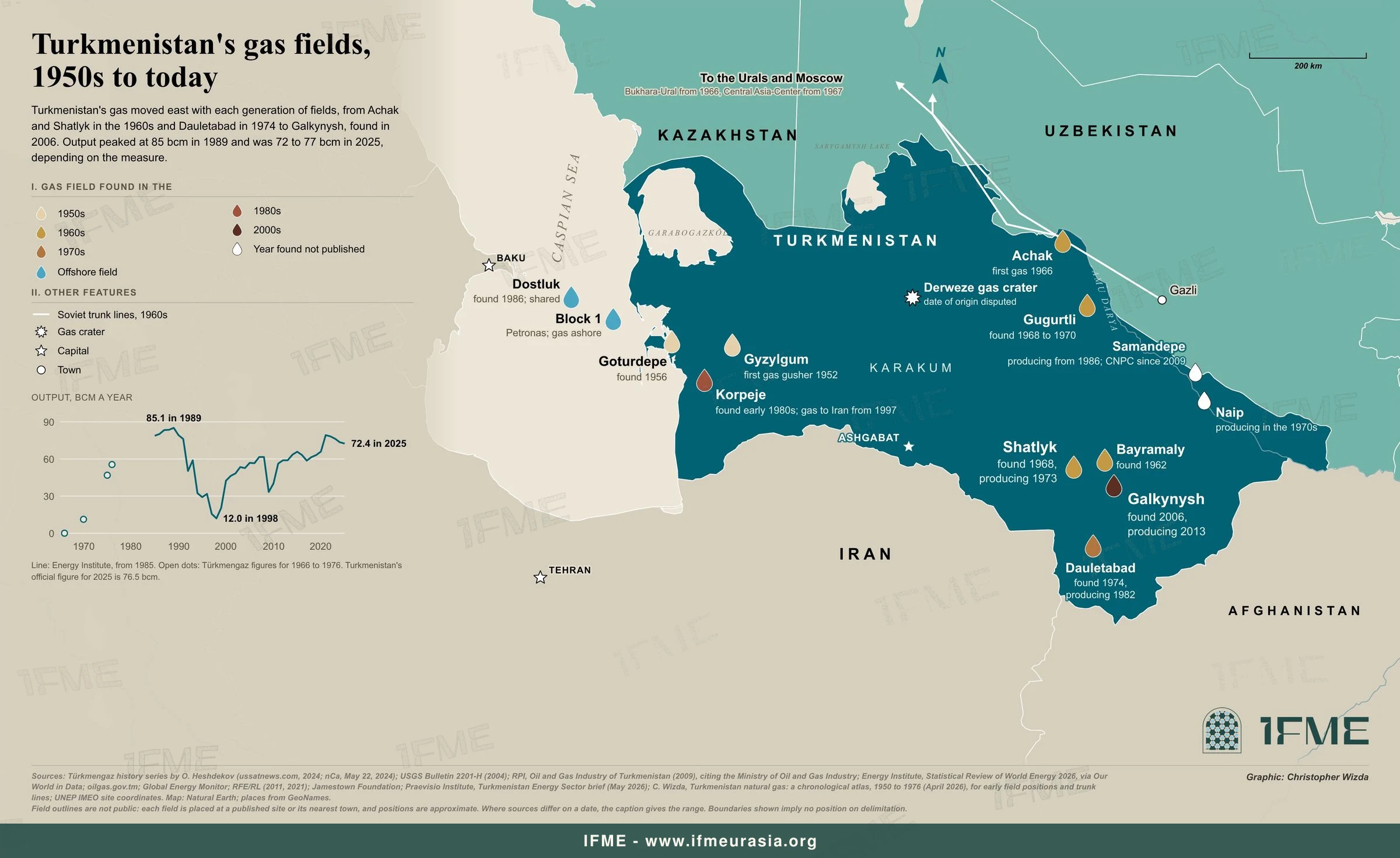
From the first gas at Gyzylgum in 1952, Turkmenistan's large finds moved east to Galkynysh, and the Energy Institute now puts the country's proved reserves at 13.6 tcm, fourth in the world. Since 2005, five plants have turned part of that gas into urea, polymers and gasoline at home, and by Turkmengaz's count, more than 477 bcm went to China between December 2009 and October 1, 2026.
The three maps follow the gas in order: the fields from the 1950s to Galkynysh, the plants that turn it into goods and power and the pipelines that carry it abroad, each drawn by its status as of October 2026.
1. Turkmenistan's gas fields, 1950s to today
Gyzylgum, in the west, gave Turkmenistan its first gushing flow of gas in 1952, and the large finds that followed moved east with each generation, from Achak and Shatlyk in the 1960s and Dauletabad in 1974 to Galkynysh, declared a discovery in 2006.
In the west, Goturdepe, found in 1956, is one of the oil and gas fields of Balkan Velayat. In the east, Achak, in the northern Karakum, sent its first gas north through the Bukhara-Ural pipeline on November 23, 1966, and in November 1967, that line was tied into the first stage of the Central Asia-Center pipeline toward Moscow. Shatlyk, found in 1968, came on stream in 1973. Dauletabad, found in January 1974, began producing in 1982. By the annual figures in the Turkmengaz history series by Oraznazar Heshdekov, output rose from 51 million cubic meters in 1966 to 55.5 bcm in 1976 (ussatnews.com).
By the Energy Institute’s count, output peaked at 85.1 bcm in 1989 and fell to 12.0 bcm in 1998, the low point of a series that begins in 1985. For 2025, Turkmenistan’s official figure is 76.5 bcm and the Energy Institute’s is 72.4 bcm. Part of that gap is a matter of method: the Energy Institute standardizes gas volumes to an energy content of 40 megajoules per cubic meter, so its figures can differ from national ones.
Field outlines are not public, so each field on the map sits at a published site, at its nearest town or at a position from the author’s 1950 to 1976 chronological atlas of Turkmen natural gas, and positions are approximate. The USGS dates Shatlyk’s discovery to 1968 and Global Energy Monitor to 1969, and accounts of the Derweze gas crater give 1963 or 1971, so the crater carries no date. CNPC has worked Samandepe, on the right bank of the Amu Darya, since 2009. Petronas brings gas ashore from Block 1 in the Caspian. Dostluk, found in 1986, is shared with Azerbaijan, which signed a memorandum on the field with Turkmenistan in January 2021.
Sources date Galkynysh, south of Yolöten in Mary Velayat, to 2003, when the structure was found, to 2006, when the discovery was declared, or to 2007, when the first well flowed. It has produced since September 2013. Stephen Wright of Gaffney Cline, the firm whose audits sized the field, gave the geological reason for the late find in a 2015 conference abstract.
“Earlier exploration drilling had failed to reach the Jurassic reservoir due to severe over-pressure being encountered in the overlying interbeded carbonates and evaporites.”
Stephen Wright, “Galkanysh: A Tethyan Super-Gaint Gas Field,” abstract, European Regional Conference and Exhibition, Lisbon (May 18, 2015).
Gaffney Cline’s 2011 audit gave Galkynysh 13.1 to 21.2 tcm, from low to high case, and the Energy Institute puts Turkmenistan’s proved reserves at 13.6 tcm, fourth in the world, in data last updated for 2020. A fourth development phase at Galkynysh, designed to add about 10 bcm a year, broke ground in April 2026.
Notes. Field outlines are not public: each field is placed at a published site or its nearest town, and positions are approximate. Where sources differ on a date, the text gives the range.
2. From gas to goods
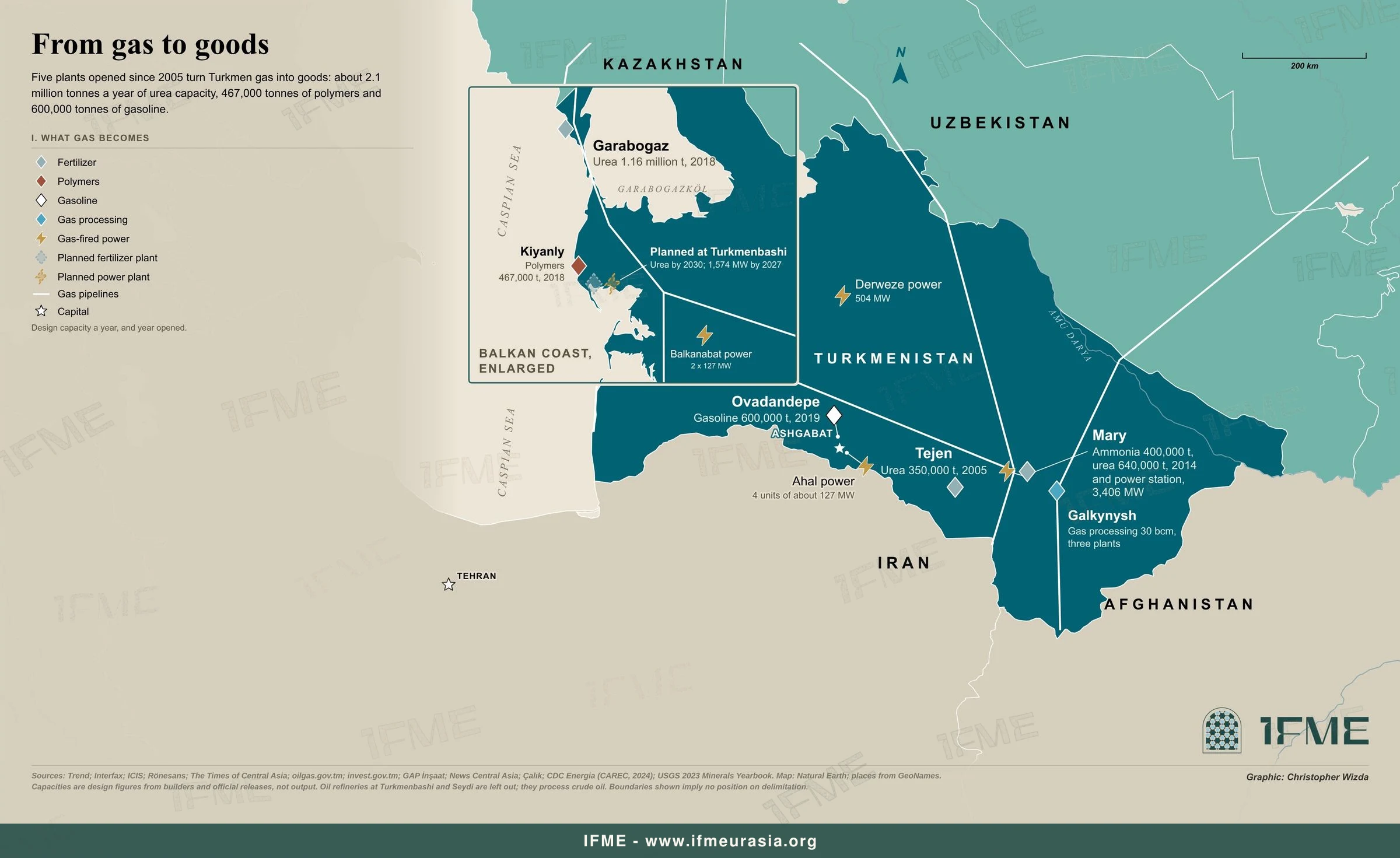
Five Turkmen plants opened between 2005 and 2019 are designed to turn natural gas into about 2.1 million tonnes of urea, 467,000 tonnes of polymers and 600,000 tonnes of gasoline a year.
Three of the plants make fertilizer. Tejen (350,000 tonnes of urea a year), built by GAP İnşaat, opened in 2005. The Mary ammonia and urea complex (400,000 tonnes of ammonia and 640,000 tonnes of urea), built by Kawasaki, Sojitz and Rönesans, followed in 2014. The Garabogaz plant on the Caspian coast (1.16 million tonnes of urea), built for export by Mitsubishi and GAP İnşaat, opened in 2018. These are design figures from builders and official releases. USGS puts Turkmen urea output at about 1 million tonnes in 2023 and rates the Garabogaz plant at 890,000 tonnes a year, both by nitrogen content, so its figures do not compare directly with the design totals. In September 2026, a government resolution set out to bring the Tejen plant to its full design capacity, Trend reported.
The Kiyanly polymer plant near Turkmenbashi, built by Toyo, LG and Hyundai and opened in October 2018 at a cost of US$3.4 billion, is designed for 386,000 tonnes of polyethylene and 81,000 tonnes of polypropylene a year. Its output went on sale on the State Commodity and Raw Materials Exchange from September 2018, in the exchange’s export trades, ahead of the plant’s formal opening.
Ovadandepe, north of Ashgabat, was built by Kawasaki and Rönesans with Topsoe technology, and by the builder’s account, it turns 1.785 billion cubic meters of gas a year into 600,000 tonnes of ECO-92 gasoline. It was commissioned in June 2019. Its first cargo went to Afghanistan that year, and Topsoe, whose process the plant uses, put full output at 15,500 barrels of gasoline a day in its release for the official opening on June 26, 2019.
“Today, a grand event marked the official opening of the world’s only natural gas-to-gasoline plant close to Ashgabat, the capital of Turkmenistan.”
Topsoe, “World’s only natural gas-to-gasoline plant in operation in Turkmenistan,” press release (June 26, 2019).
Gas also feeds the power stations that supply Turkmenistan’s neighbors. The Mary station is rated at 3,406 MW and Derweze at 504 MW, and the stations in Ahal and at Balkanabat run units of about 127 MW each. Çalık built the Mary-3 plant. In 2023, Turkmenistan sold 4,015 GWh to Uzbekistan and 1,771 GWh to Kyrgyzstan, by the count of the region’s dispatch center, and the Zerger plant in Lebap, opened in 2021, supplies Afghanistan, Uzbekistan and Kyrgyzstan.
The map leaves out the oil refineries at Turkmenbashi and Seydi because they process crude oil. At Turkmenbashi, a 1,574 MW combined-cycle power plant is due in 2027, and a new urea complex designed for 1.155 million tonnes a year is planned in Turkmenbashi etrap, with construction from July 2026 and full commissioning due by February 2030.
Notes. Capacities are design figures from builders and official releases, not output. Oil refineries at Turkmenbashi and Seydi are left out; they process crude oil.
3. Central Asia's gas routes by status
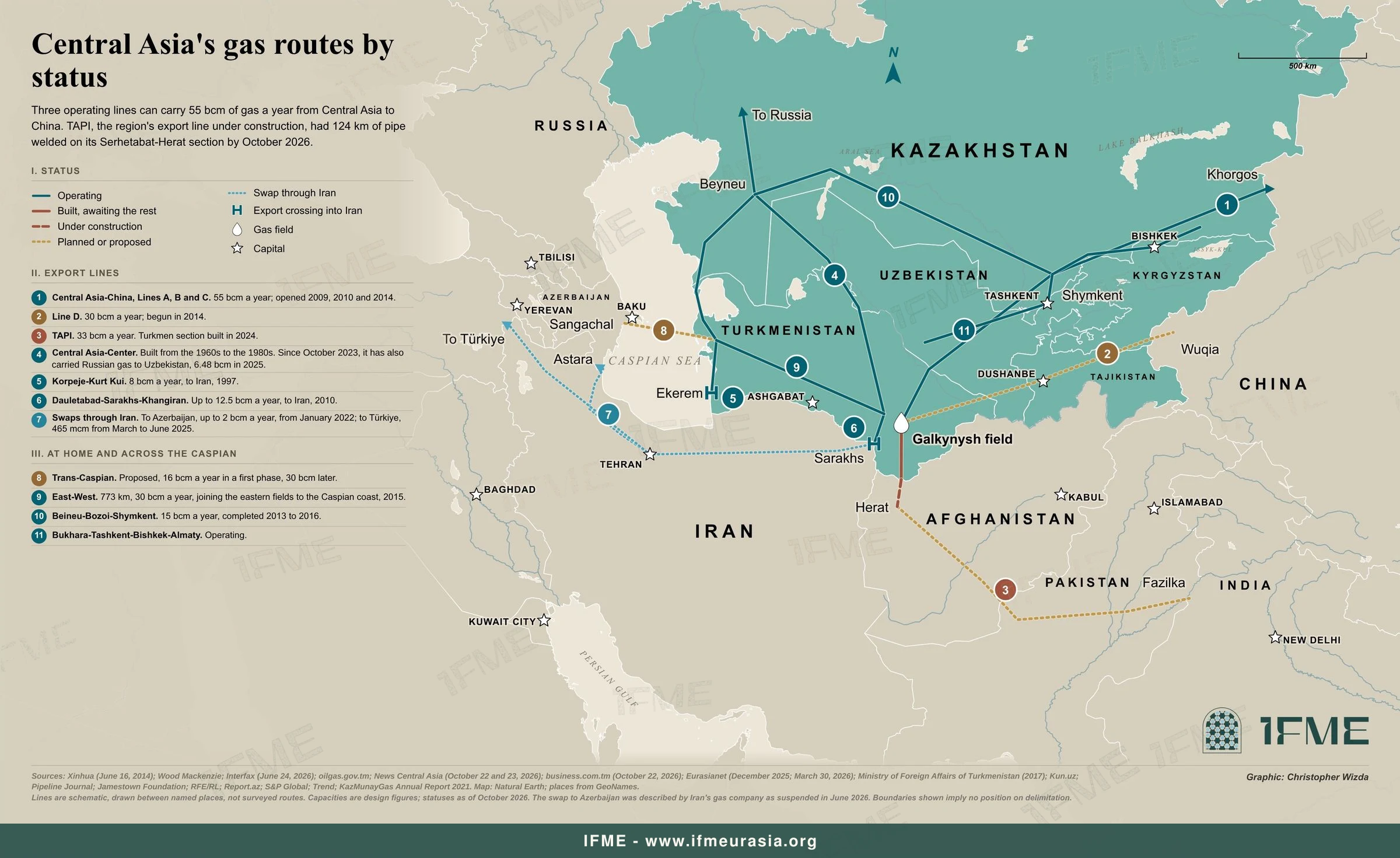
More than 477 bcm of Turkmen gas had gone to China between December 2009 and October 1, 2026, by Turkmengaz’s count, through three operating lines that can carry 55 bcm a year from Central Asia.
Lines A and B opened in 2009 and 2010 and Line C in 2014. Turkmenistan’s official oil and gas portal cites about 40 bcm a year of Turkmen gas delivered through them, and China’s ambassador to Turkmenistan, Ji Shumin, put 2025 deliveries at about 30 bcm (Eurasianet). A fourth line, Line D, would add 30 bcm a year on a route through Uzbekistan, Tajikistan and Kyrgyzstan. Work on it began in 2014; Turkmenistan lists it as planned and Global Energy Monitor as shelved, and in March 2026, the ambassador said the project was “still under discussion.”
TAPI, the region’s export line under construction, is designed for 33 bcm a year over 1,814 km, from the Galkynysh field through Afghanistan and Pakistan to Fazilka in India. Its Turkmen section was built in 2024. The Serhetabat-Herat section in Afghanistan runs 153 km, and in May 2026, Pajhwok, citing the Herat governor’s office, reported 64 km of pipe laid there. By October 2026, 124 km of pipe had been welded and assembled, Muhammetmyrat Amanov, chief executive of TAPI Pipeline Company, told the OGT 2026 conference in Ashgabat. Turkmengaz expects first gas by mid-2027, depending on the Afghan side’s readiness to receive it.
“We expect to complete the remaining part of the pipeline, hydrostatic testing and the final crossings, and to commission TAPI Herat pipeline by end of this year.”
Muhammetmyrat Amanov, quoted in “TAPI Pipeline segment to Herat Is Nearly 80% Complete, Turkmenistan Says,” News Central Asia (October 22, 2026).
The older routes still carry gas, some of it in a new direction. Built from the 1960s to the 1980s, the Central Asia-Center system has also carried Russian gas south to Uzbekistan since October 2023, 6.48 bcm of it in 2025. Two lines run to Iran: Korpeje-Kurt Kui, opened in December 1997 for 8 bcm a year, and Dauletabad-Sarakhs-Khangiran, opened in 2010 for up to 12.5 bcm. In Kazakhstan, Beineu-Bozoi-Shymkent, completed between 2013 and 2016, can carry 15 bcm a year, and the Bukhara-Tashkent-Bishkek-Almaty line is operating.
The Trans-Caspian line to Azerbaijan remains a proposal, 16 bcm a year in a first phase and 30 bcm later, and swaps through Iran’s network have carried Turkmen gas west in its place. Deliveries to Azerbaijan, up to 2 bcm a year, began in January 2022 under a contract that the head of Iran’s gas company described as suspended in June 2026, and 465 mcm reached Türkiye from March to June 2025. At home, the 773 km East-West pipeline, opened in 2015 for 30 bcm a year, joins the eastern fields to the Caspian coast. Maksat Babayev, chairman of Turkmengaz, told the OGT 2026 final press conference that Turkmenistan remains interested in the Trans-Caspian line and ready to supply it, and that supplying it would require the next phase of development of the Galkynysh field.
Notes. Lines are schematic, drawn between named places, not surveyed routes. Capacities are design figures; statuses as of October 2026. The swap to Azerbaijan was described by Iran's gas company as suspended in June 2026.