
Past event
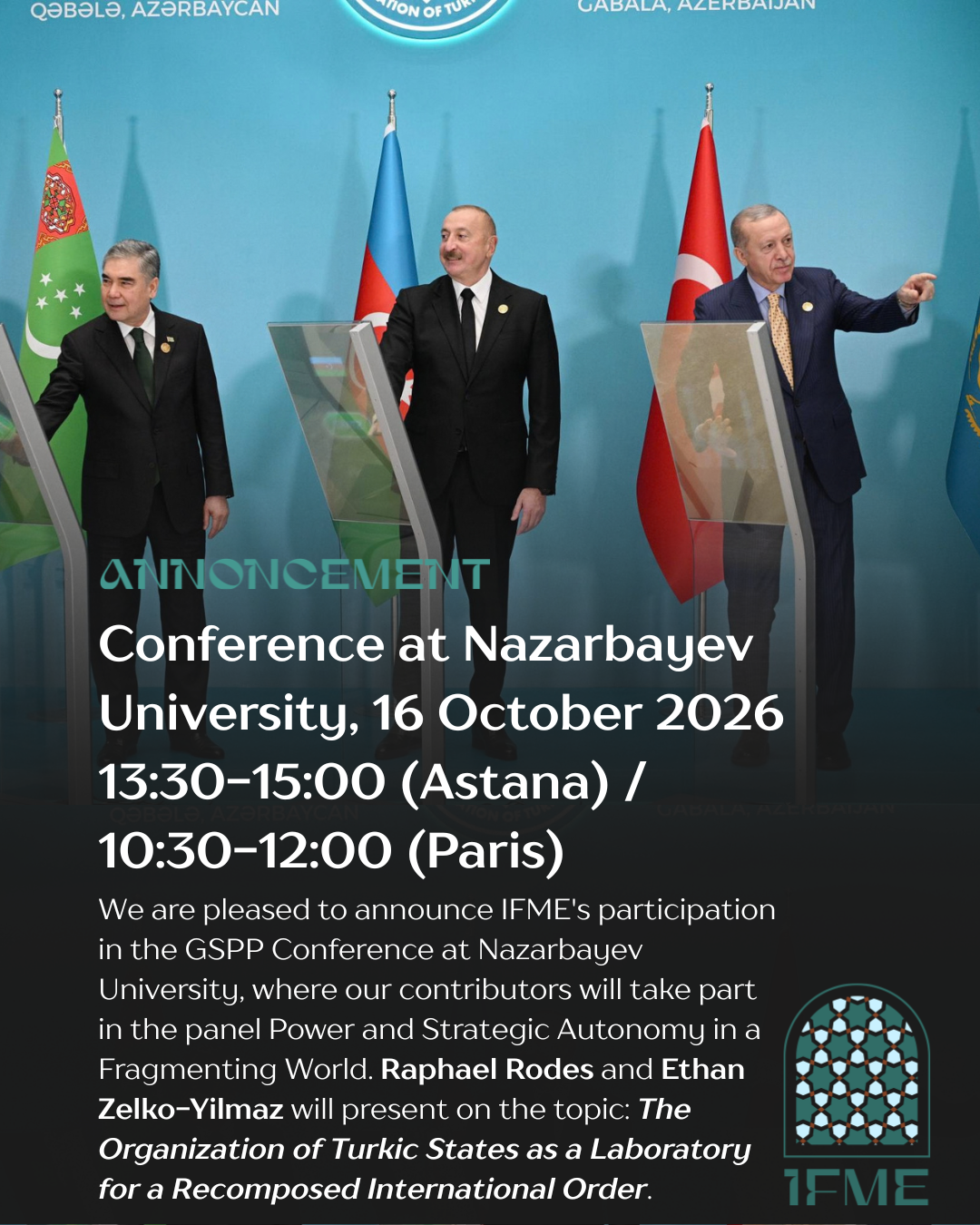
GSPP Conference 2026 - Nazarbayev University, Astana
Report
On 16 October 2026 at 10:30 Paris time, IFME researchers Raphael Rodes and Ethan Zelko-Yilmaz presented “The Organization of Turkic States as a Laboratory for a Recomposed International Order.” They spoke at the tenth international conference of the Graduate School of Public Policy (GSPP) at Nazarbayev University in Astana.
The GSPP held its tenth conference on 16 and 17 October 2026, in person and online. Its theme was “Reimagining Governance: Power, Policy, and the Public Good in a Fractured World.” The organizers asked what good governance looks like, and for whom, in a world increasingly defined by division. Panels covered public administration, AI governance, and economic, social and climate policy. Dr. Katarína Staroňová of Comenius University gave the keynote on executive control and bureaucratic autonomy. The IFME contribution was part of Panel 10, “Technology, Power and Strategic Autonomy in a Fragmenting World,” held online and moderated by Serik Orazgaliyev.
The presentation
Raphael Rodes (Ruhr-Universität Bochum, IFME) and Ethan Zelko-Yilmaz (École Pratique des Hautes Études, IFME) started from an unusual institution. Most regional organizations begin with trade or security and expect a shared identity to follow. The Organization of Turkic States (OTS) presents itself the other way round: kinship first, cooperation second. Its five members are Türkiye, Kazakhstan, Uzbekistan, Azerbaijan and Kyrgyzstan, with some 160 million inhabitants between them.
The authors traced how this kinship has been built. It runs from the Ottoman myth of the Red Apple to the renaming of the Turkic Council in 2021, when the Turkish name changed from “Turkic-speaking states” to simply “Turkic states.” They then compared two observer states. Turkmenistan, Turkic by any measure, chooses to stay out of full membership. Hungary, whose language is Finno-Ugric, was the first observer admitted.
They concluded that Turkic identity is constructed, elective and conditional. It widens where inclusion costs little and goes quiet where solidarity would be costly, as on the Uyghur question. Between Russia and China, the OTS works less as a third pole than as a space for manoeuvre. The idea of Turan, they argued, guides action more than it marks out a territory.
The presentation draws on their forthcoming book, L’Organisation des États turciques : grammaire d’une identité. It will be the first book in French devoted entirely to the organization.
Other events
- Paris Peace ForumPalais de Chaillot (Trocadéro)View the event
- L'islam en Asie centrale (Garnelle x IFME 1/4) Centre culturel des Garnelles, 6 rue Jean Nicot, 75007 ParisView the event
- Fuir, transiter, s'installer : la guerre en Ukraine et la recomposition des mobilités en Asie centraleUniversité Catholique de Lyon UCLY (amphithéâtre Merieux, Campus Saint-Paul)View the event