


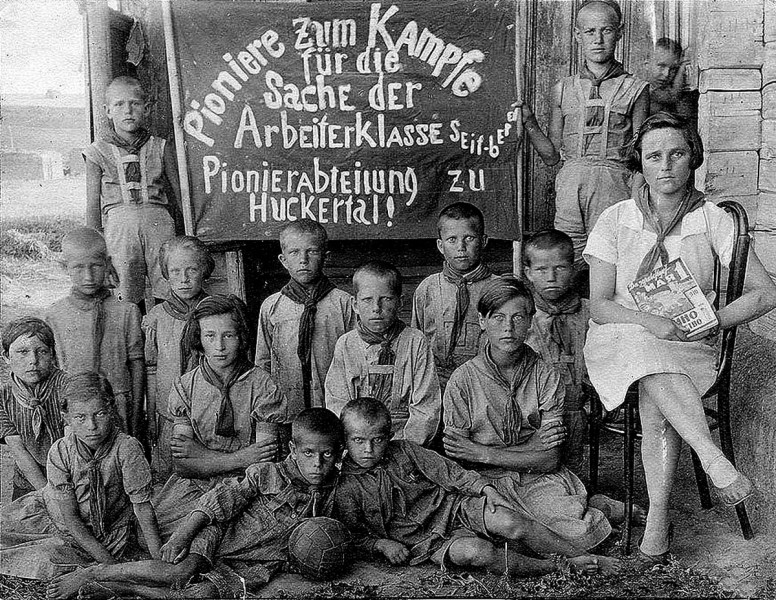
“The working men have no country” and the “supremacy of the proletariat” will cause “national differences and antagonisms between peoples” to quickly disappear. The proletariat is to “constitute itself the nation” rendering obsolete the national “in the bourgeois sense of the word.”[1] This vision of the nation as put forth in the Communist Manifesto sets an ideal for international unity of the working class. But when implementing these ideals in reality, major dilemmas arise; and as the Bolsheviks took power in an empire inhabited by many different peoples, such dilemmas became a pressing matter.[2]
Realising nations were not to disappear any time soon, the newfound Soviet government decided to use the nation to their advantage. By providing language rights and national autonomous rule to various peoples, the Bolsheviks hoped non-Russian peasantry would eventually be drawn closer to socialism.[3] “Proletarian in content and national in form—such is the universal human culture toward which socialism is marching”, Stalin remarked in 1925, and only by enriching the national cultures with “proletarian” culture, they could advance.[4] Key to this, was setting up institutions in the national languages of the respective peoples. This entailed government bodies, but also theatres, recreation clubs, print media, and schools.[5]
This study focuses on schools, specifically in the case of the Volga Germans. The latter refers to a group of people inhabiting the area around the Volga near Saratov, where many German-speaking colonists had settled since the eighteenth century, making up about 400 thousand people spread out over more than 200 colonies just before World War I.[6] As a result of the war between Russia and Germany, Germans living in the Russian Empire came under increasing pressure.[7] Plans were made to expropriate and later exile the Volga Germans, set to take place in the spring of 1917. Their execution was only narrowly avoided by the outbreak of the February Revolution, after which the Provisional Government suspended the measures.[8]
As the Bolsheviks took over in the October Revolution, the Volga Germans’ situation improved yet again. In October 1918 a decree was signed providing autonomous rule for the Volga Germans in the form of a ‘Labour Commune’, which was turned into an Autonomous Socialist Soviet Republic in 1924.[9] Simultaneously, efforts were made to reform education, including the right of education in the native language for the many different peoples living under Soviet rule.[10] Germans had been teaching in their native language already – albeit with fluctuating restrictions during the final decades of imperial rule – but regardless, the Volga German school system had to be reshaped and new books had to be written as to fit the new political situation.[11]
To investigate that process, this study focuses on a reading book published in 1924 in the Volga region, studying the primer itself, as well as public discourse its author was a part of. The book in question is Lerne Lesen: Erstes Lesebuch für die deutschen Kinder des Bundes der Räterepubliken (transl.: Learning to Read: First Reading Book for German Children in the Union of Soviet Republics), by Franz Bach (1885-1942).[12] The title makes clear it was aimed at German children in the Soviet Union, meaning not just children of the 400.000 Germans in the Volga German ASSR, but also of about 800.000 Germans elsewhere in the USSR.[13] It is hard to say how widespread this book’s usage was, though the reprint from 1927 – used for this paper – is marked as print run “37 to 46 thousand”. With about 55 thousand school-going children in the Volga region in 1922,[14] that seems to imply at least substantial engagement with Bach’s book, making it a meaningful source in studying education of the German diaspora.
Furthermore, the author has published multiple articles in the Volga German journal Unsere Wirtschaft, in which he describes his considerations in writing the book. In it Bach explains for example, that his book is to fit with the progressive ideology and methodology of the unified labour school – the new school model of the USSR –[15] but notably also that it is to be a ’Heimatbuch’, fit to the regional context of the Volga Germans.[16] The availability of the journal Unsere Wirtschaft further allows for analysis of the discursive context in which education was negotiated, allowing for a better understanding of the framework of thought within which Bach wrote his primer. [17] This makes the source of great use in studying what Stalin’s “national in form” and “proletarian in content” meant in practice when reshaping education.
Working from this source base, it will be examined how Bach’s book Lerne Lesen as well as public discourse connected to it, mediates between the national layer on the one hand, and the socialist layer on the other. To do so, the article is divided into two main parts. The first will focus on the institutional environment within which Bach’s book was written, both in terms of education itself, as well as the press media its development was discussed in. This part will start with a description of institutional changes resulting from the Revolution. Thereafter, a specific debate regarding the usage of dialect in education will be analysed, as to illustrate the dynamics of debates on education. The second part will focus on the schoolbook itself, analysing first its methodology and then its contents. Both will be studied through the material itself, as well as what the author writes about it in Volga German press.
For national policy within the Soviet Union extensive scholarly work has been done already. An example is the work of Jeremy Smith, which has been of considerable use to the present study.[18] This holds true also for the Volga German case specifically, on which multiple monographs have appeared over the past few decades.[19] Two dissertations have appeared even, focussing on education specifically.[20] These studies together make clear an extensive framework of legislation and policy was set up, granting national groups cultural rights, of which the Volga German case is one of the first examples.[21] What is still lacking however, is serious attention for the local experience that resulted from this framework. It is in this respect that the article at hand aims to contribute, looking at how the implementation of this policy was negotiated at the local level.
These studies of the Volga Germans fit with the broader trend of increased attention to the German diaspora in Russia – a now large field of study, which has gained traction since the 1990s after the collapse of the Soviet union. Within this context, there has been some attention for cultural aspects like religion and language. But, as noted by historians Katrin Boeckh and Dmytro Myeshkov, their functioning as part of a Russian German collective identity has not yet been researched.[22] By researching the role of national identity in shaping national education, this article aims also to address this gap in current historiography.
Volga German context of education debates
New Soviet policy regarding national groups, meant that local languages were to be used in local institutions. This pertained to political institutions, but also to education and press media. Both Germanophone press and education had already been established in the Volga German area during the nineteenth century.[23] Still, the Revolution meant they had to change greatly. The educational reforms implemented by the Soviet government affected the framework within which Volga Germans operated in reshaping their education. How the press-media environment developed, influenced the space within which these educational were negotiated. This section will therefore give an overview of developments in the print-media landscape within which Franz Bach found himself when writing his primer; as well as a discussion of the new framework for education which the state implemented.
The very first German-language newspaper in the Russian empire had already been established in 1727 in St. Petersburg,[24] long before Germans settled around Saratov. When those Germans did settle there however, this newspaper only sporadically made it to the colonies, and it would take until the 1860s for more structural distribution of German press to emerge. Though still limited, it allowed for a connection through print media with German communities elsewhere in the empire – especially the Baltic area, Lodz, Odessa and Moscow.[25] Around this time, Volga Germans also started small-scale production of newspapers themselves.[26] This would not increase in scale until after the Revolution of 1905. Most publications started in this area would only last a few years however, with almost all disappearing when German print media was banned in 1915.[27]
When the tsarist government was brought down in 1917, Volga German press was enthusiastically rebuilt, at first with a great plurality of journals. For example, the socialist newspaper Der Kolonist was established, and the Catholic Deutsche Stimme aus dem Wolgagebiet was created.[28] The October Revolution quickly put an end to this however, with the Bolsheviks essentially banning all existing Volga German press again. Der Kolonist was eventually allowed to continue under the new name Der Kommunist; and Nachrichten was set up as a newspaper for official communication by the Volga German authorities, appearing two or three times per week.[29]
In the years following the October Revolution, multiple communist journals were established in the Volga Area, most of them quickly disappearing again as well. One journal established during this period that stuck around a bit longer, was Unsere Wirtschaft, running from 1922 until 1927.[30] It was a journal published twice a month by the region’s economic council, citing as its task the provision of information to the farmer population on the state of agriculture and economy of the region, as well as on matters of science and culture. In the latter two categories – and for some time in an extra supplement – often articles were published specifically on education.[31]
The journal was quite popular, operating independently from the regional communist party committee, but it would seem also in close relation to them. Most contributions in the journal come from normal individuals or sometimes groups of specialists; in September 1923 two texts appear communicating a German version of policy introduced union-wide, with the journal functioning in this instance also as a state communications medium. They were statutes for the new schooling model, the unified labour school, along with a brief overview of the programme that was to be introduced there.[32] This union-wide model for schools set the space within which education was to be set up and discussed. Essentially, it meant there was now to be only one type of school for all children aged 8 to 17; private schools, or schools on a religious basis were banned. This new school was to be ideological in its basis, teaching children about class war and the legitimacy of the Revolution.[33]
Progressive teaching methods were to be introduced. This meant adopting the ‘complex method’, which entailed moving away from teaching by subject, instead linking different disciplines in a general ‘complex’ theme. These themes were to be tailored to children’s experience of the world, as well as being socially oriented. These themes were to be approached from three basic perspectives: nature, society and labour.[34] In the short curriculum published in Unsere Wirtschaft this is clearly visible. For the first year of school, the first period is to be dedicated to “nature and man”, covering the four seasons; the second period is dedicated to labour, going over what this looks for both a family living in the village and one living in the city, talking about their activities for every season.[35]
The statutes published in Unsere Wirtschaft were a translation of a Russian document which had been adopted about six months prior, in May 1923.[36] Their implementation can be seen as an attempt to harmonise the divergent situation in Volga German education that had emerged during the Civil War. In schools there had been a mix of teachers sticking with traditional methods and teachers enthusiastic for innovative educational aims of the new government.[37] Furthermore, these statutes required teaching in the native language. Though for German-language existed already in the region, this still presented difficulties, as the Revolution had taken its toll on the Volga Germans. In 1921 a devastating famine struck, form which the schooling system was still recovering in 1923. Also, many deemed ‘bourgeois’ were in exile or silenced, together with non-Bolshevik socialists, while others had been drafted into the Red Army. This meant but few members of the German intelligentsia were left to help reshape and rebuild the educational system.[38] Still, over the following years this was managed, as the number of schools and capable teachers grew slowly but steadily.
It has become clear then in this brief review of changes in Volga German educational and press-media institutions, that the Revolution had left a deep impact. For Volga German press, the February Revolution had been mainly a positive development. As the ban on German-language publications was lifted, a great multitude of journals emerged, only for most to be quickly banned again after the Bolsheviks took power in the October Revolution. A Bolshevik-aligned press remained though, providing a platform for government communications, as well as public discourse. Such public discourse also entailed discussions of the educational system, which was undergoing great changes. The Revolution and the ensuing civil war had left the system in shambles. With the violence over, it was now the task of the few German-speaking intellectuals left to rebuild the educational system in accordance with new Soviet principles of education. The reformed Germanophone press was an important place in which this process was negotiated, as shall become clear in the following sections.
Debate on dialects in education
Part of the debate on education in the native language was on what language variety was to be used. A discussion on this was conducted in Russian German journals in early 1924, starting with a message in Nachrichten from the teachers’ association in the town of Balzer. At their meeting on February 9, they had discussed what version of German was to be used in school: dialect or literary language. According to the message, most teachers believed the literary language was to be used primarily, supported by the dialect when needed. Others believed that the dialect had no place in school whatsoever, “since the way of speaking of our people cannot be seen as a dialect, as it has changed so significantly”, likely implying it had Russified. It seems a compromise was made in the resolution they adopted, deciding to leave up to the teacher to choose between teaching either in dialect or in the literary language.[39] This decision led to multiple responses, one appearing in Nachrichten itself, as well as two in Unsere Wirtschaft – one of them by schoolbook author Franz Bach – and even one in the Moscow-based journal Die Arbeit. Their debate will be analysed here, as to illustrate the dynamics of public discourse on education in Volga German press, giving special attention to the role of nationality in their framework of reference.
The first traceable response came from philology student Franz Schiller (1898-1955), with his article appearing in Nachrichten over the course of 12 and 13 April – a month after the Balzer teachers’ resolution. He agrees the literary language should be central in education, as it is the language used by state officials, and he believes that German-language press will significantly expand. But he resents the idea that “our colonist dialect” has changed so much under Russian influence, that it can no longer be called German; it is an idea that can be found not just among the Volga German people themselves, but also in “Moscow scholarly circles”. But “[o]ur dialect is still being spoken today in some places in Germany, [and] it has changed only phonetically”, he asserts. Using Germany as a reference point, he argues it is therefore perfectly fit to be a part of both lower and higher education.[40]
Paying no attention to the dialect would be anti-proletarian even Schiller believes. He laments how the pre-Revolutionary intelligentsia would speak “only in Russian, and out of contempt turned their back on their own colonist language [i.e. local dialect] – turned their back on the farmers”. Besides, occasionally using the dialect can help clarify difficult matters. Always relying on the literary language can prove difficult especially for young children who – coming into school for the first time – would have only heard dialect being spoken around them. Schiller further asserts that using the dialect in such a supporting manner is something also being done in Russian schools; and ends by saying the workers must “come to understand and respect” the “colonists’ language”; not out of some “dumb nationalism”, but because “the Soviet government has given us colonists the right to our own national development”.[41] Schiller seems to pre-emptively defend against accusations of nationalism, asserting embrace of the national tradition is actually precisely what the Soviet government intends for them.
Furthermore, it should be noted how Schiller positions the German community in relation to the Russian or Soviet people. He refers to scholarly circles in Moscow – though it is not entirely clear whether he means German-speaking or Russian-speaking intellectual society; he points to Russian school practice in advocating the use of dialects as a supportive tool; and he points to the Soviet government and how it has endowed the Germans with the right to national development. At the same time, he also uses Germany as reference point in arguing the dialect can justifiably be used in education. It is different in the two articles in Unsere Wirtschaft that are part of this discussion. Their articles seem to be positioned in an exclusively German space, in which there is no reference to people outside of it.
A few weeks after Schiller’s article, two more responses appeared: the first one by Franz Bach on April 30, the second one by Professor Georg Dinges (1891 – 1932) on May 15.[42] Content-wise, they are similar to Schiller’s article, both advocating for using dialect in education as a supporting tool. Bach’s article is – like Schiller’s article – a direct response to the statement put in Nachrichten by the teachers of Balzer. He is also responding to another article however, written by a certain “comrade” Josef Ruß, who had responded to the Balzer teachers’ decision as well, doing so in Die Arbeit, a German-speaking journal based in Moscow.[43]
Bach’s article starts out by expressing his confusion over why the teachers adopted a resolution in which they were forced to choose either dialect or literary language for education. If indeed – as the statement in Nachrichten claims – the majority of teachers was in favour of using dialect as a supportive tool in education, then why does the adopted resolution not reflect this? Bach then goes on to their dismissal of the local dialects as German; “How someone can even say such a thing?!”, he exclaims, going on to point out that foreign words being introduced in a dialect is normal, as “our Volga colonists use fewer Russian words than the inhabitants of some frontier areas of Germany, or the Swiss with French words”.[44] Just like Schiller, he brings up Germany as a point of reference, though in a slightly different way. Schiller argued the Volga dialect was still being spoken in some parts of Germany; but Bach has a different view (and points out also the plurality in speech varieties among the Volga Germans), arguing rather that the level of foreign influence in their dialects is similar to that in dialects of Germany.
A final defence of the dialect comes from Professor Georg Dinges, who as a scholar did extensive dialectological research among the Volga Germans.[45] His article is written in the first place as a response to Josef Ruß’ article in Die Arbeit – to which Bach was also responding. The title of Ruß’ article was “High German, dialect and Dinges”, so it is not surprising this provoked a response from Dinges himself. From the two articles in Unsere Wirtschaft we can make up that Ruß had replied to the Balzer teachers, like Bach pointing out their mistaken line of reasoning on the dialects’ russification; but also using an article by Dinges to argue for excluding dialects from schools.[46]
Dinges insists Ruß had misread his article though, and defends the importance of the dialect, both in education and as an important cultural element. He even quotes Goethe’s words: “Every province loves their dialect, because it is actually that element from which the soul draws its breath”. These words of Goethe are often cited in German scientific literature Dinges says, without them doing any damage to Germany’s schools. And he furthermore brings up the writing of Gerhart Hauptmann – a highly regarded Nobel laureate German poet from Silesia –[47] who Dinges says is also considered a “dialect poet”. Through Goethe and Hauptmann, Dinges brings up German norms to defend the importance of dialects.[48] So, just like Schiller and Bach before him, he too takes Germany as a point of reference.
What stands out in the dynamics of this debate, is that it takes place almost entirely in an isolated German-speaking bubble. Bach and Dinges refer at no point to anyone outside of it. Schiller is an exception to this, making a reference to the Russian schooling system and the Soviet Government. But even with him, like with the other authors, Germany is an important point of reference in defending the status of the local dialect. Another feature shared among these authors, is their valuing of the Volga German dialect. They appreciate its cultural importance as “our colonists’ language”, and emphasise its connection to Germany. This is most clear in the articles by Schiller and Dinges, less so in the one by Bach who talks about the dialect in a more instrumental sense – but it seems likely he would have shared in such appreciation of the cultural value as well, as he has himself published multiple plays in dialect.[49] A final remark then, is that attitudes towards the dialect would change strongly over the next decade; speaking the dialect came to be seen as kulak and fascist, resulting in them being outright banned from education in 1936. Schiller’s idea that using the dialect was to be in solidarity with the farmers was reversed.[50]
“What kind of reading primer do we need?”
That is the question Franz Bach poses in June 1923 in an article of the same title, published over the course of two editions of Unsere Wirtschaft. In the first paragraph of the article, Bach explains clearly what he sets out to do:
The old schoolbooks with their in part useless, in part damaging contents, with their outdated methods and their other unsuitable elements for the new unified labour school, are gradually disappearing in our German schools […]. Therefore, it is necessary to create new books suiting our circumstances, among other things a reading primer (Fibel), or better, a first reading book (erstes Lesebuch). The procurement of such a book has to be the most burning question of this day in respect to elementary education […].
In the rest of the article, he explains what he believes such a reading primer without “damaging contents” and “outdated methods” should look like.[51] A year later, in 1924, the project is finished and Bach publishes his primer Lerne Lesen. In what follows, first the methodology Bach applies will be analysed, followed by the book’s contents, using as a source the book itself, as well as articles from Unsere Wirtschaft.
Methodology
Bach explicitly names alignment with “the principles of the labour school” as an important aim of a new reading primer. He elaborates, saying this requires “that the reading and writing education does not become something isolated, existing on its own and being a goal in itself”. As fits with the “complex method” that was to be practiced in the unified labour school,[52] this meant bringing the reading education into connection with other subjects in the school curriculum. Bach emphasises the need for engagement of “not only eyes and ears, but also the hands”. A tactile element was to be implemented, such as cutting letters from paper, or drawing. But Bach also proposes something more unusual: “the assembly of the characters for a certain word, or for its components (sounds, sound combinations) using rods specifically made for it (straight, bent ; whole, half and quarter rods)”, to be used particularly in the first year of education.[53]
This system with rods is one of the points criticised by elementary school teacher J.J. Fischer, who published a review of Bach’s book – as well as several other schoolbooks in use in his school – in Unsere Wirtschaft in May 1925. “My children get tired of placing characters and rods and long for variation ; they wish to write, and to satisfy them I had to start teaching Latin writing script.” A point of criticism related to this, is that Bach’s choice to introduce only one writing system – the so-called Steinschrift, deemed insufficient as well as too boring for first-year students by Fischer. It would leave too much for the second and third years of school; after all – Fischer remarks – German children had to learn twelve different kinds of print and writing letters: Latin, Gothic and Russian scripts in four different variations.[54]
Bach’s choice to write his book entirely in Steinschrift was certainly a conscious one though. He writes in his article that “the usage of German [i.e. gothic] writing and print letters confuses the children” and therefore “reading will first be learnt using only print letters, which is preferable of course to learning to read and write at the same time using only cursive.” He specifies furthermore, that it is best to use “the old Latin script (Antiqua), and more precisely to use the Steinschrift”. This script is international, and will therefore need to be learned anyways, Bach explains, and it is the easiest to learn for children, since print and cursive are the same. Also, it allows for more “labour processes” to be applied, as using his rods and cutouts would be much harder with the gothic letters.[55]
His choice is somewhat surprising if we consider the existing reading books Bach had studied. In his article, Bach references several authors of primers who he divides into two groups: one group consists of authors of pre-revolutionary reading primers that were being used in the Volga German schools; the other group are pedagogues from Germany, publishing reading primers in the few years before him. One of the pre-revolutionary authors he mentions is a certain Wagner, whose reading primer Bach says was in use “in the Baltic provinces (Ostseeprovinzen), [and] in part also with us in the Volga area and in other areas of Russia”.[56] Unlike the other two reading primer authors he mentions (Brendel and Schölzel), Wagner’s book is traceable and accessible.[57]
If we compare the first page of Wagner’s book (fig. 1), to the first page of Bach’s book (fig. 2), it becomes clear what he is seeking to depart from. Wagner starts out by using gothic script, immediately providing both the print letter and the cursive version. Taking a close look at it makes it easy to understand why Bach wanted to move away from this. In the cursive, the letters “I”, “n”, “u” and “m” are only distinguishable by a flick or dot above them, and even in print “u” and “n” are not far apart. As such, it is no surprise perhaps that Bach was not the first to come up with this idea; and he readily acknowledges he was influenced in this by pedagogues in Germany. Specifically, he references the reading primer “Ich will dir was erzählen” (1922), a primer for children in Hessen, written by Otto Zimmermann.[58] It was a variation of another primer Zimmermann wrote for children in Hamburg.[59] This version is accessible, and allows for comparison to Bach’s work.[60]
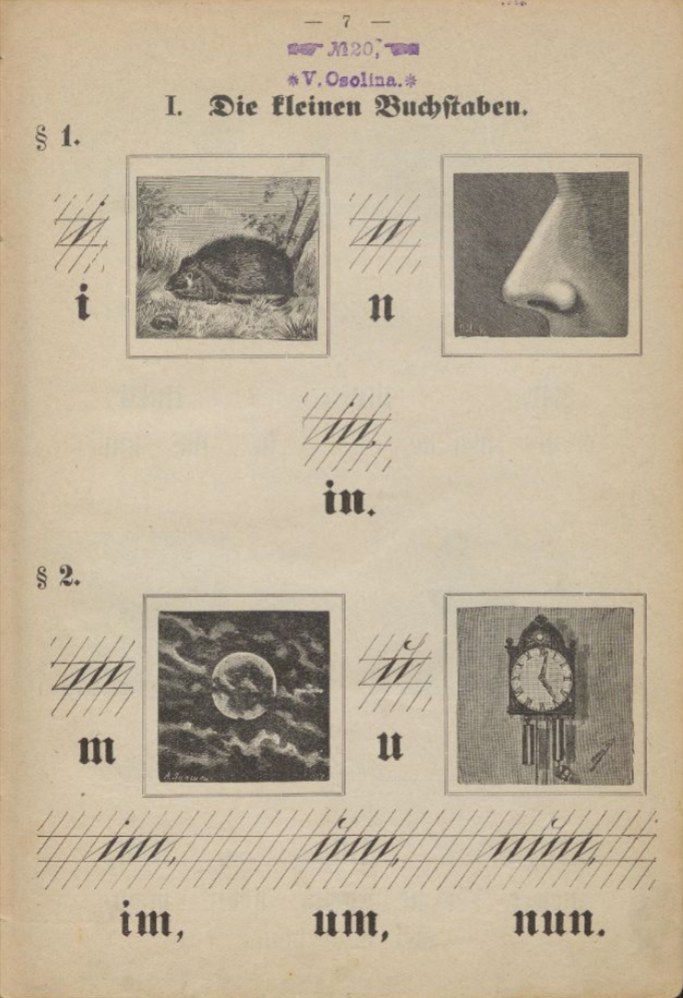
Fig. 1. Wagner, Deutsche Fibel (Riga, 1907): the opening page, in Gothic type, giving each letter as both print and cursive.
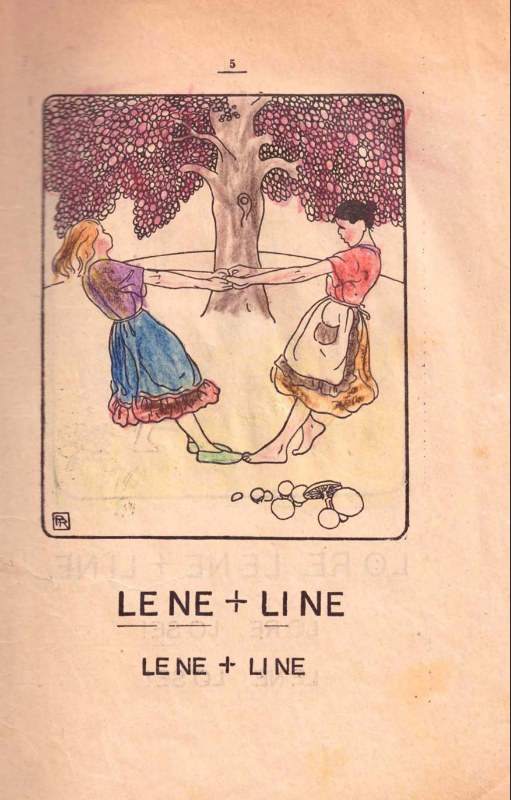
Fig. 2. Bach, Lerne Lesen (Pokrowsk, 1924): the opening page, set in Steinschrift and built from two-syllable names.
If we compare the first page of Bach’s book to the first page with full words on Zimmermann’s book (fig. 3), we see he too uses Steinschrift. What Zimmermann does differently however, is that he eventually switches to gothic script (fig. 4). Why Bach does not do the same is not clear, with him emphasising even the importance of Gothic as the most beautiful in the teaching instruction in the back.[61] Regardless, his inspiration on Zimmermann’s reading primer is clear and goes beyond just the script, extending also to the overall layout of the book: both use stylised images which take up a large amount of space, markedly different from Wagner whose images are more realistic in style, often using multiple small images on a page rather than a single large one.
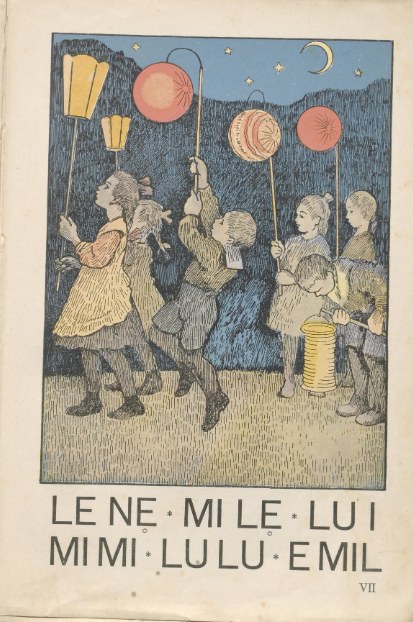
Fig. 3. Zimmermann, Hansa-Fibel (Hesse edition, 1922): the first page of full words, likewise in Steinschrift.
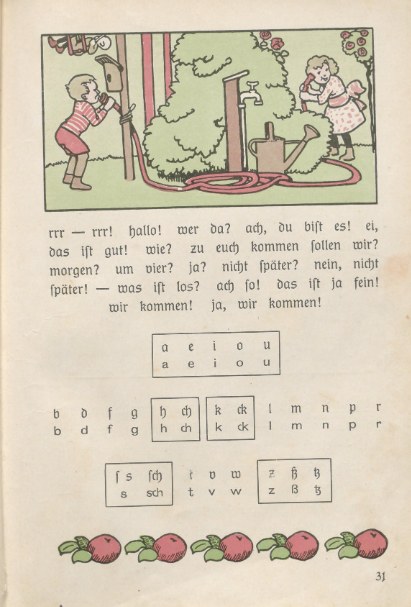
Fig. 4. Zimmermann, Hansa-Fibel: a later page, where the primer turns to Gothic script and sets Fraktur beside Antiqua.
Bach differs from both books though by starting out teaching single letters, but starting with syllables. This is a methodological innovation Bach talks about at length, coming down to a rejection of the so-called Buchstabiermethode and the Lautiermethode which were widespread in schools in Germany during the nineteenth century. The former means starting out by learning the letters’ names, used then to spell out words (e.g. ‘Em-Ay-En: Man’).[62] The Lautiermethode involved a focus on phonetics, focussing on how consonants and vowels worked together to create sounds.[63] Bach despised it just as much, if not more. The system he builds involves teaching two-letter syllables to children, showing how they build words.[64] Its practical application is clear on the first page of the reading primer (fig. 2), starting out with two-syllable names “Le ne + Lo re” rather than single letters like Wagner and Zimmermann (fig. 1 + 3). It seems to sit in between the Buchstabiermethode with its focus on word image, and the phonetics of the Lautiermethode in focussing on the interaction between syllables in creating words. This too did not win Fischer’s sympathy, in whose experience the Lautiermethode remains more effective. [65]
As such, Bach had taken the Soviet government’s aim for innovative education to heart. He actively sought ways to depart from pre-Revolutionary work, rejecting older methods. By adding a tactile element, he tried to connect to the ‘complex method’ which the 1923 statutes required. This framework stipulated but few details, allowing Bach quite some space for experimentation. We also see the difficulties arising from this, as clear from Fischer’s criticism on the primer’s methodology. Furthermore remarkable, is that Bach paid attention only to books from the German-speaking world in his methodological considerations. This is despite similar books having been produced for Russian in the years prior. [66]
Contents
Fischer is more positive regarding the book’s contents, writing that “[t]he primer is well-illustrated ; […] the reading exercises start with entire representations straight out of the children’s life; […] the more advanced material is taken from the farmers’ and workers’ life and is just as interesting and accessible as well as useful to the children.”[67] As such, Fischer sums up accurately what the book touches upon: it includes scenes from in and around the house, about animals and nature, but also about farmwork in the countryside and of artisans in towns. It matches well with the themes included in the curriculum of the unified labour school, which for the first year names “nature and man”, “society” and “labour” both in the “village family” and the “city family” as topics that should be touched upon, ideally linked to the different seasons as to best match the child’s experience.[68] On that last point Fischer does complain: though the book includes stories set in the different seasons, due to their order they do not match with the actual seasons; Fischer finds that the book is hard to use when practicing the unified labour school’s ‘complex method’, not just in the aforementioned methodological practices, but also in its set-up content-wise.[69] But still, the themes of the unified labour school’s curriculum are touched upon.
Regarding the theme “society”, this required also familiarisation with meaning of class struggle, as an important ideological goal of the unified labour school.[70] This ideology does not permeate every story from the book – far from it even, with most stories being very universal in their themes and told in an ideologically neutral way, though avoiding what Bach calls “religious and capitalist”favourite themes”“.[71] In stories on labour and society ideological themes appear implicitly. This is most clear in the stories”the blacksmith”, “the other artisans” and “the land worker”, followed by the poems “the good worker (Arbeitsmann)” and “the good farmer (Bauersmann)”;[72] in these stories the implicit message is the primacy of the working class, and the importance of good relations between the farmers and workers.
In a set of texts near the end of the book – as such being more advanced – messages about socialism and the Revolution are presented more explicitly as well. For example, in the text “The First of May” Bach writes:
“[i]n our country the working people and their children are happy that they have a government that takes care of the workers and farmers as much as possible, and that defends them from enemies abroad. But in other countries, where the enemy of the workers and farmers govern, it is often not allowed to hold May celebrations on the street. The working people and their children assemble in the woods or somewhere free. There they all promise each other they will fight on until they too have a workers’ and farmers’ government, like us, their brothers in the land of the soviets.”[73]
The text tries to make clear to the children, using simple language and talking in a manner to fit their level of understanding, that May Day is connected to class struggle. It is a militant message, implying the Soviet government is something that needs to be fought for, and as such something they should be grateful for.
On the page following it, it becomes clear how they as children might take part in Soviet society. It shows a picture of children marching in a row, with one boy in front carrying a flag (fig. 5). Underneath it there is a short verse including a German version of the pioneers’ greeting: “The pioneers are on their way/They shout out loud: Hurray, hurray!/The first ones greet: Be ready!/And the others: always ready!”. It is followed by a text on a pioneer summer camp, describing a rather militant game the children play, performing a small-scale re-enactment of the Civil War, with one side playing the “Red Army”, the other “white gangs”; the latter of which had to lose of course.[74]
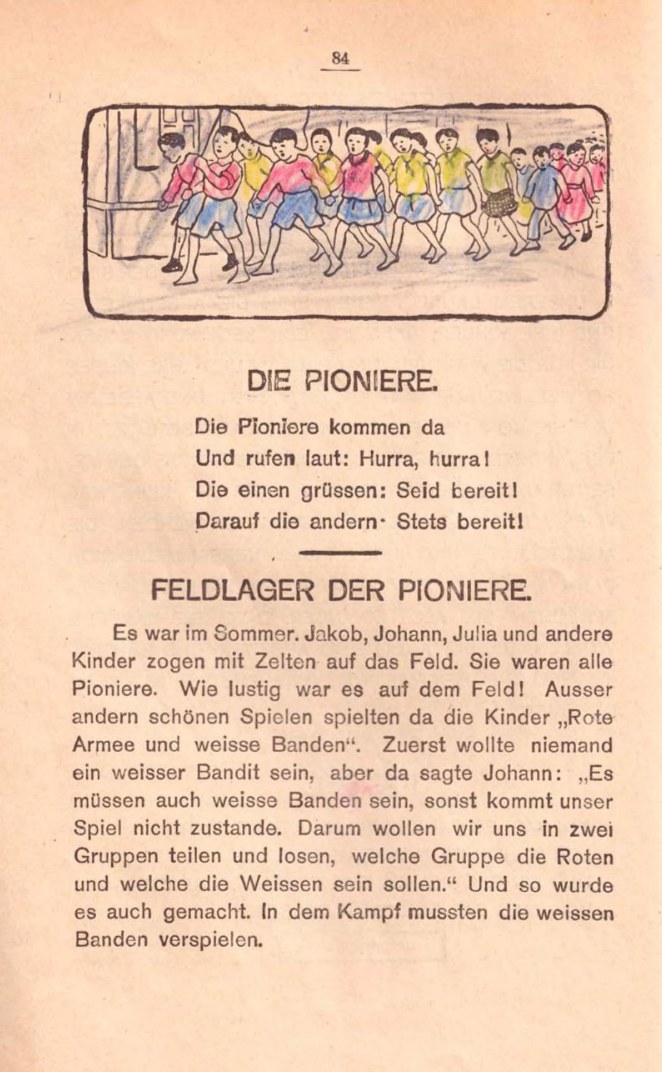
Fig. 5. Bach, Lerne Lesen, p. 84: “Die Pioniere”, the Young Pioneers on the march.
Two pages ahead there is not a text, but a selection of portraits, titled “The great leaders of the proletariat”, showing pictures of Marx, Trotskii, Lenin, Lunacharskii and Clara Zetkin (fig. 6).[75] The inclusion of this non-textual page in a reading primer is remarkable, and its intention is not specified; presumably the teacher was meant to use the illustration to explain these figures’ noteworthiness. The last person included is especially an interesting pick, as Clara Zetkin was a German and active in the German Communist Party (KPD). She had a strong connection to the Soviet Union though, having visited it multiple times and being on good terms with Lenin.[76] As such, on this most explicitly socialist page, Bach includes a connection to Germany, the only such connection explicitly made in the book.
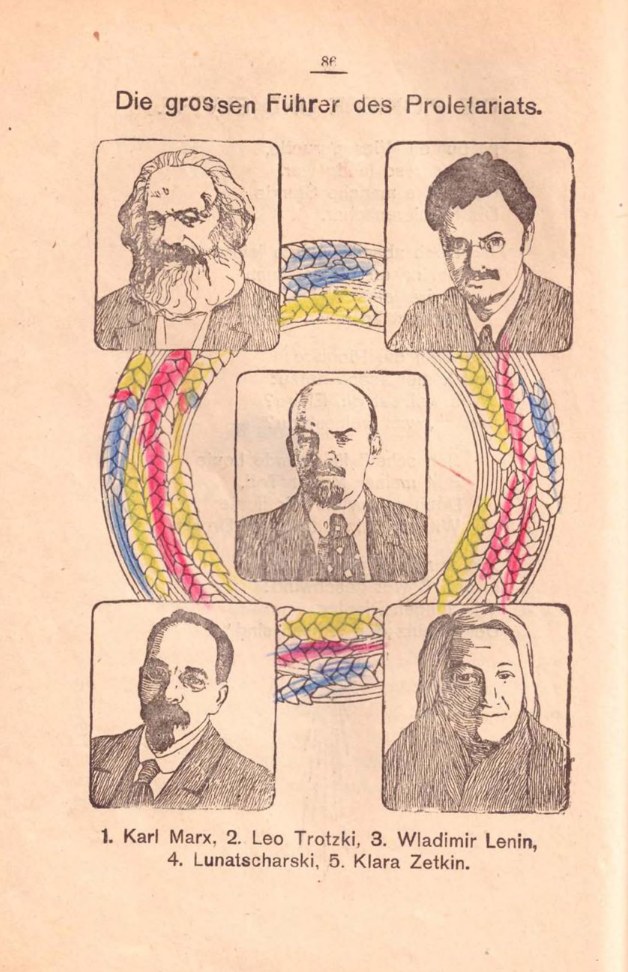
Fig. 6. Bach, Lerne Lesen, p. 86: “Die grossen Führer des Proletariats”, showing Marx, Trotsky, Lenin, Lunacharsky and Zetkin.
Other than that, the only connection to Germany is an implicit one, in that Bach directly copied quite several texts from Zimmermann’s reading primer. Overall, Bach was very positive about Zimmermann’s book,[77] and as such he has copied multiple of the thematically neutral texts. Often, he made subtle changes, switching out certain names or words – perhaps those he felt were less familiar to Volga German children. An example is the text “Feuer! Feuer!” (fig. 7 + 8), where the text is almost the exact same, though with a new picture, some words switched out, and the name “Heini” for “Adam”. In other texts Bach copied, he switched the name Heini out as well, though often replacing it with the closely related “Heine”.[78] This kind of copying can be identified for about twenty texts in Bach’s primer. But at the same time, Bach has his reservations in making use of Zimmermann’s work, as “[t]he first reading book or primer must be a Heimatbuch”, and there are stories in Zimmermann’s book that are too “foreign” for “our children”. As examples he cites multiple texts, among them “Reith, Heini, reit” talking about a carousel, and “Die Turner”, about a boy practicing gymnastics – apparently elements not present in the Volga colonies.[79]
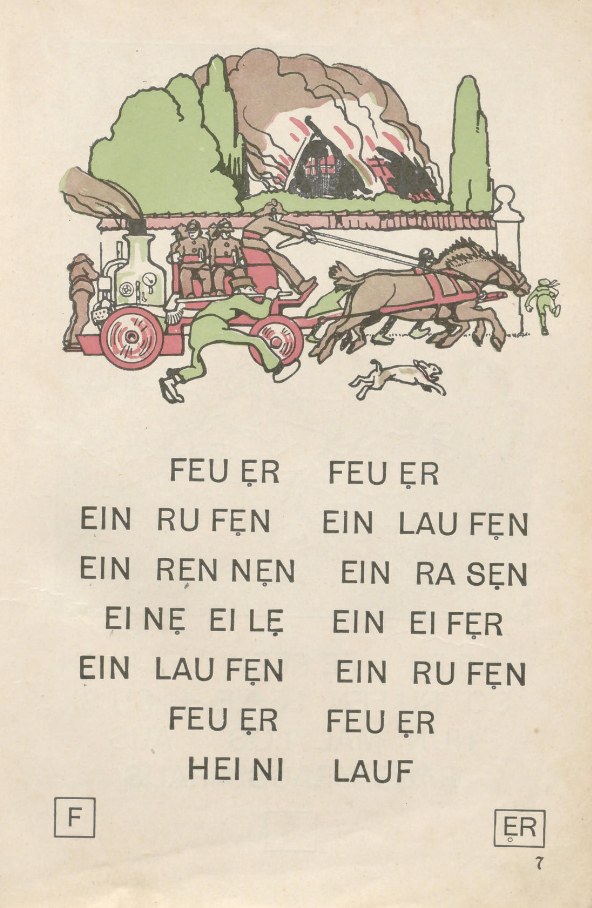
Fig. 7. Zimmermann, Hansa-Fibel: “Feuer! Feuer!”, the model Bach worked from, in which the boy is “Heini”.
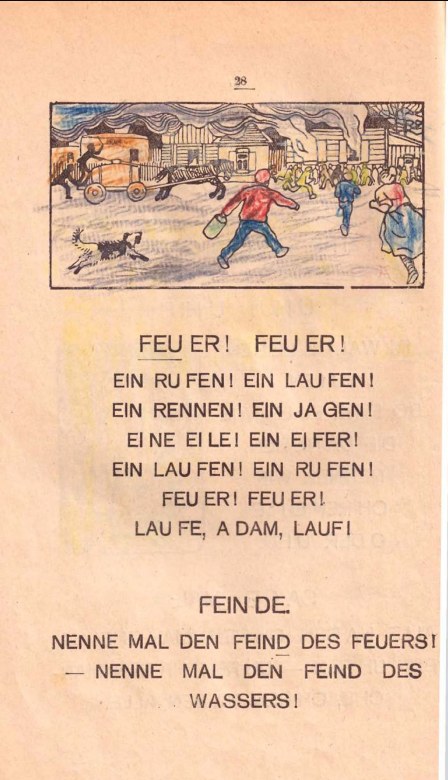
Fig. 8. Bach, Lerne Lesen: the same “Feuer! Feuer!” text reworked, the boy now renamed “Adam”.
But then what does Bach include to tailor his primer to the Volga German homeland (Heimat)? Any sort of ‘Germanness’ seems to be absent, except for in the names of characters. Rather it is about depicting the world that is familiar to children, which does not necessarily mean elements specific to the Volga German environment, but mostly just excluding unfamiliar topics. An exception to this is the text “To Mariechen Bienemann in Leninburg”, a letter in which Anna writes to her cousin Mariechen, asking her to send a Russian book, because she wants to learn to read and write in Russian.[80] The idea seems to be here that cousin Mariechen lives in a Russian town (‘Leninburg’), as such having easy access to Russian books; a situation that could only be recognisable from the viewpoint of Russian German children. It is the only story that deals with a theme specific to the national group the book was aimed at, as all the other stories deal with quite universal themes.
So, content-wise, there is hardly any explicit connection to Germany, or Germanness more broadly. But – just like for his methodology – Bach does look for inspiration in Germany. He copies texts from a German primer from Hessen, though filtering topics unfamiliar to children in the Volga region, or going against socialism. Hardly any trace of national identity can be found in the book, but the socialist component has a very clear presence, both implicitly and explicitly. As such, the book aligns itself with the ideological goals set for education by the Soviet government, as well as adhering to its thematic aims more broadly.
Conclusion
The aim of “national form” and “proletarian content” certainly holds up in Franz Bach’s primer Lerne Lesen, as well as in the public discourse surrounding it. Being Volga German does not lead to direct contradictions with the socialist ideology that was to be upheld in the unified labour school. In the educational content of Bach’s primer, the national identity moves almost entirely to the background; it is rather in the underlying framework of thought that the German identity remains meaningful. As such, Germanness in connection to other ‘colonists’ of the Volga area, other Germans in the Soviet Union, as well as Germans back in Germany, is very important in public discourse on educational practices; and in that respect it is also undeniably very influential in Bach’s considerations in setting up his primer.
This connection to the broader Germanophone world was not new. As the distribution of German-language press from all across the empire became a structural matter in the second half of the nineteenth century, this connection was already being made, though often rather limited or under pressure. Though the Revolution initially meant a revival of Volga German press, restrictions came in place again after the Bolsheviks took charge. Still, the Bolshevik-aligned press provided an important space to discuss educational reforms. Looking at such discussions, it becomes clear that through press media, the Volga Germans still remained connected to the rest of the Germanophone world. In part this is by engaging Germans living elsewhere in the Soviet Union (Moscow in particular), but also in that Germany keeps being used as a point of reference. Examples from there are used to support arguments, and appeal is made to the norms in force there. Tying back to historiographical debate on the German diaspora, the shared point of reference and normativity appears to Germany here, indicating a collective “German” identity carried meaning to intellectuals involved in the debate on dialects. This is yet underpinned by their appreciation of the cultural value of these dialects, for which the relevance of their connection to Germany is argued by all three authors in question.
Their debate almost entirely takes place in a Germanophone vacuum, clearly visible as well in Bach’s primer and the articles underpinning it. In his considerations on how to go about this he looks exclusively at fellow Russian Germans, as well as Germans back in Germany. Rejecting the German primers in use before the Revolution, Bach does not look upon similar undertakings already in place for Russian; but rather he turns to a primer from Hesse, back in Germany, copying texts from it and choosing a similar layout. He rejects the traditional methods of Buchstsabieren and Lautieren that were in use in German pedagogy before, and sets up his own system based on syllables.
At the same time Bach’s endeavour fits well within the Soviet government’s educational efforts. With the region’s educational system in shambles after the Civil War, and much of its intelligentsia gone, Volga German education was in a process of slow recovery when Bach was writing his schoolbook. At the same time, the government sought to reshape education, aligning it with socialist ideology and implementing progressive educational policies. Studying Bach’s project and the discourse surrounding it, it appears there was quite some autonomy at the local level for the implementation of this educational innovation. Bach did make an effort to align his book with the curriculum stipulated by the Soviet government, but in doing so still had quite some freedom to experiment as he himself saw fit. For inspiration he looked even beyond the Soviet world, onto Germany, with the journal Unsere Wirtschaft providing a platform for him to share this with his equally German colleagues, from whom in return he could also expect fierce criticism.
As a final remark then – as a short epilogue – it should be said that this early period in Soviet history saw particularly positive developments for the Volga Germans, and as such this paper shows their position under Soviet rule as almost exclusively beneficial to them. Though laying beyond the temporal scope of this study, it cannot go unsaid that the situation would turn around quickly in the 1930s under the Stalinist terror – as a result of which Franz Bach, as well as the dialectology professor Georg Dinges were to perish, along with many others.[81] Things went further downhill as World War II broke out. Whereas during the First World War the Volga Germans had been saved from deportation by the downfall of the tsar, this time no such luck befell them, as the Volga German ASSR was disbanded and over a million Russian Germans were sent to Kazakhstan and Siberia, causing hundreds of thousands to perish.[82] The ambitious attempts at setting up innovative education, and relatively free discussions within Volga German public discourse that are described here, appear then as an almost idyllic calm before the storm.[83]*
Bibliography
Secondary sources
Bartnitzky, Horst, “1904–1931: Fünf Reformfibeln.” Schulfibeln.de., 2024.
Berend, Nina, and Rudolf Post. Wolgadeutscher Sprachatlas (WDSA): Aufgrund der von Georg Dinges 1925–1929 gesammelten Materialien. Tübingen and Basel: A. Francke Verlag, 1997.
Boeckh, Katrin. “Stand und Perspektiven der Historiographie zu den Russlanddeutschen.” In Jenseits der „Volksgruppe”: Neue Perspektiven auf die Russlanddeutschen zwischen Russland, Deutschland und Amerika, edited by Viktor Dönninghaus, Jannis Panagiotidis, and Hans-Christian Petersen, 251–64. Berlin and Boston: De Gruyter Oldenbourg, 2018.
Bourret, Jean-François. Les Allemands de la Volga: Histoire culturelle d’une minorité, 1763–1941. Lyon: Presses Universitaires de Lyon, 1986.
Britannica. “Gerhart Hauptmann.” Accessed June 1, 2026. https://www.britannica.com/biography/Gerhart-Hauptmann.
Bundesstiftung Aufarbeitung. “Zetkin, Clara.” Accessed June 1, 2026. https://www.bundesstiftung-aufarbeitung.de/de/recherche/kataloge-datenbanken/biographische-datenbanken/clara-zetkin.
Cieszkowski, Marcin. “Zur Sowjetisierung der wolgadeutschen Sprachvarietät in den 20er- und 30-er Jahren.” In Kontinuität und Variabilität in Sprache, Linguistik und Fremdsprachenvermittlung, edited by Danuta Olszewska, Andrzej Kątny, and Anna Socka, 40–55. Gdańsk: Wydawnictwo Uniwersytetu Gdańskiego, 2015.
Demoscope.ru. “Demograficheskie pokazateli po 15 novym nezavisimym gosudarstvam” [Demographic indicators for the 15 new independent states]. Accessed June 1, 2026. https://www.demoscope.ru/weekly/ssp/ussr_nac_26.php.
Ditts, Ia. Istoriia povolzhskikh nemtsev-kolonistov [History of the Volga German colonists]. Moskva: Gotika, 1997.
Fitzpatrick, Sheila. Education and Social Mobility in the Soviet Union, 1921–1934. Cambridge: Cambridge University Press, 2009.
Gartvig, B. V. Narodnoe obrazovanie v Avtonomii nemtsev Povolzh'ia (1918–1941 gg.). [National education in the Volga German Autonomous Region (1918-1941)] Samara, 2004
German, A. A. Istoriia Respubliki nemtsev Povolzh'ia [History of the Volga German Republic]. Moskva: MSNK-press, 2000.
German, A. A. Nemetskaia avtonomiia na Volge. 1918–1941 [German autonomy on the Volga. 1918-1941]. Moskva: Gotika, 2007.
Geschichte der Wolgadeutschen, “Bakh Frants Iogannovich.” Accessed June 1, 2026. https://lexikon.wolgadeutsche.net/article/13.
Gottzmann, Carola L., and Petra Hörner. Lexikon der deutschsprachigen Literatur des Baltikums und St. Petersburg: Vom Mittelalter bis zur Gegenwart. Vol. 1. Berlin: De Gruyter, 2007.
Grenoble, Lenore A. Language Policy in the Soviet Union. New York, Boston, Dordrecht, London and Moscow: Kluwer Academic/Plenum Publishers, 2003.
Koch, Fred C. The Volga Germans: In Russia and the Americas, from 1763 to the Present. University Park and London: The Pennsylvania State University Press, 1977.
Myeshkov, Dmitry. “Wo steht die Russlanddeutschenforschung? Einige Beobachtungen zur wissenschaftlichen Tagung ‘Russlanddeutsche in einem vergleichenden Kontext: Neue Perspektiven der Forschung / Russian Germans in a Comparative Context: New Research Perspectives’ im November 2015.” In Jenseits der „Volksgruppe”: Neue Perspektiven auf die Russlanddeutschen zwischen Russland, Deutschland und Amerika, edited by Viktor Dönninghaus, Jannis Panagiotidis, and Hans-Christian Petersen, 265–76. Berlin and Boston: De Gruyter Oldenbourg, 2018.
Reißig, Tilo. “Die Geschichte des Orthographieunterrichts im 19. und 20. Jahrhundert.” In Weiterführender Orthographieerwerb, edited by Ursula Bredel and Tilo Reißig, 48–80. Baltmannsweiler: Schneider Verlag Hohengehren, 2021.
Schneider, Wolfgang. Lesen und Schreiben Lernen: Wie erobern Kinder die Schriftsprache? Berlin and Heidelberg: Springer, 2017.
Smith, Jeremy. “The Education of National Minorities: The Early Soviet Experience.” The Slavonic and East European Review 75, no. 2 (1997): 281–307.
Smith, Jeremy. The Bolsheviks and the National Question, 1917–23. Basingstoke and London: Macmillan, 1999.
Vashkau, Nina Ėmil’evna, Dukhovnaia kul'tura nemtsev Povolzh'ia: Problemy shkoly i obrazovaniia 1764–1941 gg. [spiritual culture of the Volga Germans: Problems in schools and education]. Saratov, 1998.
Wheatcroft, Stephen G. “The Scale and Nature of German and Soviet Repression and Mass Killings, 1930–45.” Europe-Asia Studies 48, no. 8 (1996): 1319–55.
Primary sources
Bach, Franz, Lerne Lesen: Erstes Lesebuch für die deutschen Kinder des Bundes der Räterepubliken. Pokrowsk: Nemgosisdat and Zentrisdat, 1927. Accessed June 1 2026 through: https://wolgadeutsche.net/library/item/914.
Deutschde Digitale Bibliothek, object record “Ich will dir was erzählen : Erstes Leseb. f. hessische Statkinder auf Grund d. Hansa-Fibel Otto Zimmermann”. Accessed June 1 2026 through: https://www.deutsche-digitale-bibliothek.de/item/7G7FLWPPUKGNDXT6AAWENVLL3HDG2DWD.
Dinges, Georg, “Über unsere Mundarten”, In Beiträge zur Heimatkunde des Deutschen Wolgagebiets, edited by Georg Dinges. Pokrowsk: Verlag von der Abteilung für Volksbildung des Gebiets der Wolgadeutschen, 1923.
Marx, Karl and Engels, Friedrich, Manifesto of the Communist party. and its genesis. Pacifica: Marxist Internet Archive, 2010.
Schiller, Franz, “Volksbildung. Die Unterrichtssprache in unseren Schulen”. In Nachrichten nr. 83 + 84 (1924), 4 and 4.
Unkovskaia, S. A., Azbuka “Pervaia zimka” [Alphabet book “First Winter”]. Tver': Tverskoe izdatel'stvo, 1922. Accessed June 1 2026 through: https://rusneb.ru/catalog/000199_000009_007903534/, document code 000199_000009_007903534.
Vakhterov, V. P., Russkii bukvar'. Ispravlennoe i dopolnennoe izdanie [Russian primer: Revised and Expanded Edition]. Moskva. Accessed June 1 2026 through: https://rusneb.ru/catalog/000199_000009_009155856/, document code 000199_000009_009155856.
Wagner, F.H., Deutsche Fibel für den vereinigten Schreib-, Lese- und Sprachunterricht. 6th ed.: Riga: Verlag von C.J. Sichmann, 1907. Accessed June 1 2026 through: https://gei-digital.gei.de/viewer/fullscreen/PPN1913057372/1/, persistent identifier PPN1913057372.
Zimmermann, Otto, Hansa-Fibel: erstes Lesebuch für Hamburger Kinder. Edition K, 10th print; Braunschweig, Berlin & Hamburg: Verlag Georg Westermann, 1929. Accessed June 1 2026 through: https://resolver.sub.uni-hamburg.de/kitodo/PPN1725577585, object ID PPN1725577585.
Unsere Wirtschaft
All articles from Unsere Wirtschaft have been accessed through the online archive Geschichte der Wolgadeutschen, “Unsere Wirtschaft. Organ der Ökonomischen Beratung des Gebiets der Wolgadeutschen”. Accessed June 1 2026 through: https://wolgadeutsche.net/newspaper/12.
Bach, Franz, ‘Schriftsprache oder Mundart?’, Unsere Wirtschaft 3.8 (1924): 213-215.
Bach, Franz, ‘Was für eine Fibel brauchen wir?’, Unsere Wirtschaft 2.11 (1923): 334-336.
Bach, Franz, ‘Was für eine Fibel brauchen wir?’, Unsere Wirtschaft 2.12 (1923): 363-367.
‘Die Statuten der Einheitlichen Arbeitsschule’, Unsere Wirtschaft 2.17 (1923): 490-494.
Dinges, Georg, ‘Schriftsprache, Mundart und Dorfschule’, Unsere Wirtschaft 3.9 (1924): 254-256.
Fischer, J.J., ‘Bericht über meine Arbeit nach dem ersten Lesebuch „Lerne Lesen” von F. Bach (für die Zeit vom Oktober 1924 bis zum März 1925)’, Unsere Wirtschaft 4.10 (1925): 46-48.
‘Kurze Programme der Einheitlichen Arbeitsschule nach dem Schema des Volkskommissariats für Volksbildung’ Unsere Wirtschaft 2.21 (1923): 621-623.
Pannestiel, Gottschalk, ‘Daiwelskunscht. N luschdigi Gschicht vun Gottschalk Pannestiel’, Unsere Wirtschaft 5.37 (1926): 599, 600.